
Monday, 30 September 2013

This is David Lander / David Harper

Genre: Mockumentary
Channel: Channel 4
Transmission: David Lander (31/10/1988 - 05/12/1988) - David Harper (02/11/1990 - 07/12/1990)


One of the joys of the 1980s/90s was seeing the portly journalist Roger Cook with a mouthful of hard evidence chasing crooked individuals down the street. This was on TV, of course, not down our respectable street where the only argument we remember was over a missing tin of Pease Pudding. Anyway, The Cook Report was a wonderful piece of investigative journalism, but also quite hilarious. No matter what Cook threw at the conmen, they would vehemently deny every single accusation and claim to be a victim of Cook. Occasionally, they also punched him in the face. Channel 4 decided that the show was ripe for a spoofing and spoof they did, first with This is David Lander and then This is David Harper.


This is David Lander/Harper followed David Lander (Stephen Fry) or David Harper (Tony Slattery) as they investigated dodgy business practices and the individuals behind them. Subjects at the scrutiny of either Davids included: fine art theft, schools for young genii and housing developments prone to arson attacks. The show was a mockumentary and followed the format of The Cook Report very closely featuring interviews with victims, background investigations and finally a confrontation at the end. Many established and rising comedy actors feature throughout the series such as Caroline Quentin, Tony Robinson and Neil Pearson. We were also overcome with joy when we saw a brief cameo from Ian Sears of Johnny Jarvis fame. Curiously, Stephen Fry was unavailable for the second series, so the show was renamed with Fry's erstwhile Footlights colleague Tony Slattery in the lead role.


The origins of This is... can be found in the BBC Radio 4 show Delve Special which featured Stephen Fry as David Lander and ran between 1984 - 1987. Delve Special was written by Tony Sarchet who had previously written for Jasper Carrott and Spitting Image. Sarchet felt that the idea was strong enough to translate to the small screen, but strangely, the BBC did not and, instead, Channel 4 aired the show in 1988 and 1990. A total of 12 episodes were produced by the comedy powerhouse Hat Trick. Both series were later repeated on the Paramount Comedy Channel in the late 90s.


The repeats aired on the Paramount Comedy Channel were Curious British Telly's introduction to the world of investigative Davids. The Paramount Comedy Channel (now Comedy Central) was a treasure trove of cult comedies during the late 90s airing a mixture of British and US shows such as Monty Python, Drop The Dead Donkey and Duck Man to name but a few. School holidays always meant staying up late for Curious British Telly and - in the absence of the internet - we would while away the hours with Paramount. They were formative times indeed and This is David Lander was one show which really stood out.


Tony Sarchet is on excellent form throughout This is... and his writing really defines the show. It's quite simply hilarious and at first glance, you'd think sections of the show had been lifted from Brass Eye, The Day Today or Big Train. However, This is... predates those three shows by several years and it's a shame that Sarchet didn't do more on British television. He shows here that he's capable of creating wonderful microcosms where the most ludicrous events can take place. One of our favourite scenes of This is... sees an interview with a man who's had monkey testicles implanted in his cheeks as part of weight loss therapy. When not creating surreal images, Sarchet is poking fun at the ridiculousness of authority such as the salty sea admiral who claims "It's bloody rude!" for taxpayers to complain about how their money is spent. After all, "They've handed it over.".

Stephen Fry and Tony Slattery are the face of This is... and their deadpan presentation is the perfect helm for the show. We prefer Fry's Lander as he comes across slightly bumbling and terribly English  whereas Slattery's Harper is more of a hardnosed individual. One slight issue with both David's is that we don't really get a true sense of the character. There's no background revealed to indicate his drives and passions. We're not looking for Alan Partridge style revelations here as they would spoil the realism of the production. Something more along the lines of Louis Theroux and his self-deprecating humour would have helped define the character more.

Having aired a couple of series, and with Stephen Fry at the helm, we were surprised to find there had been no commercial release of This is... We'd love to see it, but the lack of interest online is likely to be the reason why. The complete series can be found on YouTube, but annoyingly, the David Lander series is blocked in the UK by Channel 4 due to copyright reasons. It's possible to use a proxy website to get around this, but you sometimes have to persevere with videos stopping after five minutes. Why the show isn't on 4OD is another question we'd love to know the answer to. Hopefully it will be one day. The David Harper series isn't - for some reason - blocked on YouTube, so that's available for you to soak up it's confrontational charm.

Sunday, 22 September 2013

Mick and Mac

Genre: Children's
Channel: BBC1
Transmission: 03/01/1990 - 21/03/1990


One of the shows which kickstarted Curious British Telly's descent into half-forgotten TV hell was the mysterious Sebastian the Incredible Drawing Dog. A show that we could vaguely remember enjoying from our youth which featured Michael Barrymore and art. One day, whilst flicking through some old Radio Times at the British Library, we stumbled across a children's TV show which, again, consisted of Michael Barrymore and art. We almost fell off our chairs at the prospect of another Barrymore show to investigate, but thankfully we weren't drunk and remained seated. The show in question was Mick and Mac, so let's take a look.

Mick and Mac is set in delightful apartment of the time - complete with avocado green bathroom - which is home to the cartoonist, Mick (Michael Barrymore). Strangely, Mick's drawing board is also home to a miniature Scottish character called Mac (David Jarvis). The show starts with a bit of banter between Mick and Mac before Mick sits down to draw a cartoon. These cartoons feature the Mac family on mild adventures. They're most static cartoons, but there's the occasional bit of animation such as the character's mouths moving. Following this cartoon there's a Barrymore solo piece where he goofs about trying to complete tasks such as wallpapering or hoovering.


Mick and Mac ushered in the 1990s with its first episode airing on 3rd January 1990. The series consisted of twelve 10-minute episodes and was part of the CBBC programming on BBC1. Directing the proceedings was Nigel Douglas whose impressive CV includes work on Grange Hill, Going Live, This Life, London's Burning, Eastenders, The Bill and Wild at Heart to name but a few. The writing duo behind the show were Geoffrey Atkinson and Andy Walker - we can't find any information on Andy Walker, but Atkinson has a long list of credits in sketch shows and even Sky's infamous sitcom Heil Honey, I'm Home! Curiously, the credits list 'The Mac Family' as being devised by Michael Barrymore, but, as we'll learn, this wasn't strictly true.

Curious British Telly must have watched Mick and Mac at some point when it was on, but the only thing that rang any bells was the design of the set. YouTube is home to a 20 second clip of Mick and Mac, but that's pretty much all we could find online aside from a few murmurings on internet forums. 20 seconds of footage gave us very little to go on, apart from providing some screenshots, so we had to saddle up and head to the BFI archive to investigate. The technician at the BFI actually asked "What on earth are you watching today?!", which led to a wry smile from us, but also some fear that we were in for something less curious and more baffling.


The show is very reminiscent of Sebastian the Incredible Drawing Dog, featuring Barrymore, slapstick and a cartoon in the middle. However, where that show had plenty of interaction between Sebastian and Barrymore, there's very little interaction between Mick and Mac. In fact, in the episodes we watched, Mac is barely present at all beyond the first third of the show. We think this is the major stumbling point of the show as Barrymore needs to be bouncing off other people. Mick and Mac leaves him to his own devices for far too long and he just can't carry off the slapstick sequences on his own. He's a great presenter, but he's certainly no Rowan Atkinson when it comes to a silent performance with inanimate objects. The cartoons featuring the Mac family aren't particularly strong either and we can barely remember them a week later.

Overall, we were disappointed by Mick and Mac and think that the BFI technician was right to be bemused by our viewing choice. There was potential in Sebastian for Barrymore to be at the helm of a great children's show, but Mick and Mac just doesn't play to his strengths as an individual. Maybe we watched a couple of weak episodes, but they were episodes one and two, so it's not a great start to the series if so. Bringing Mac into the show more would have helped, but his existence as a miniature character living on a drawing board rather limited the role he could play. You have to understand that Barrymore in 1990 was becoming a huge name on British television and this was years before any of the scandals landed which blighted his career. If the right format could have been found then we we think a very special show could have been made. Sadly it didn't, so it will have to be filed as one of the missed opportunities of British television.

We would be very interested in viewing some more episodes of Mick and Mac to get a better feel for the show, so if you have any footage please get in touch.

INTERVIEW

Director Nigel Douglas spared us some time for a quick chat about the series for which we are eternally grateful.

CBT: You’ve had a long and successful career behind the camera, but what first piqued your interest in directing? As a child did you pick up an 8mm camera and try to remake Ben Hur in your garden or did this passion develop later on?

Nigel: I began my career as a director in Theatre in fact although my interest in writing pre dated that. Throughout my school years I was always more interested in the way school plays were produced rather than being in them. I started writing in earnest at University and was fortunate enough to have a couple of plays produced. This led to me wanting to direct theatre. It was really a piece of good fortune that saw my move to the screen. Angela Beeching, who was then producer of Jackanory, was looking for someone as an Assistant Producer who could abridge and adapt Children’s novels for the programme. She had seen one of the plays I had written and directed and offered me a six month contract. I stayed in Children’s television for around 3 years then directing The Satellite Show, Going live, FLIP, Mick and Mac, The Biz and Grange Hill before finally getting a break in the adult world on Eastenders for producer Jane Fallon (Ricky Gervais’ partner) who I then went on to direct This Life for. The rest as they say is history.

A quick flick through your CV reveals that you had worked on several BBC1 children’s shows leading up to Mick and Mac, so was it this good relationship which led to you getting involved with the show?

There was a series of factors that led to my involvement with Mick and Mac. I had begun developing FLIP when Chris Pilkington, the exec producer for children’s light entertainment, approached me about working with Michael Barrymore. They had had several meetings prior to this and Michael was keen to expand his workbase. I liked Michael’s comedy work and could see how this might be incorporated into a tv programme. I was also working a lot for Chris Pilkington at the time so it became obvious this was meant to be.

We noted – in the credits – that Michael Barrymore devised the Mac family, so was he behind the show’s inception or did he come on board later?

No, Michael was not particularly involved in the concept or development of the show. Often major stars, as Michael was then, are given additional credits to help get there fee closer to what’s required. Michael was earning 8k a night then and children’s tv had relatively small budgets. Of course, once we got closer and into rehearsals the content was almost entirely driven by him.

Michael Barrymore had been hosting Strike it Lucky for a few years by the time Mick and Mac came along, so it’s fair to say he was already a household name. How was he on set? A consummate professional? Or maybe a diva demanding nothing but blue M&Ms?

Michael was an absolute pleasure to be with from beginning to end. I had worked considerably with many of the “alternative” comics of the day such as Steve Coogan, Harry Enfield and Mel and Griff, but I have to say nobody had made me laugh as much as Michael. We would often have to stop rehearsals because he and I would be laughing too much to remember what we were rehearsing. Of course, most of this could not be put in a children’s comedy show. He was very professional during the recording.

Mick and Mac has a very slapstick feel to it with Barrymore bringing to mind the antics of Buster Keaton, Charlie Chaplin and Rowan Atkinson. Due to the physicality and reliance on props, was it a particularly difficult show to direct?

All shows throw up different challenges to direct. The hardest thing with Mic and Michael was keeping Michael somewhere near the script. Often he would improvise and I’d have to just try and go with the flow. The programme was shot on 5 cameras at Pebble Mill so mostly I was directing from the gallery.

Just one series of Mick and Mac was produced, but were there ever plans to record more and, if so, what scuppered them?

There was some discussion of a 2nd series but trying to find some time in Michael’s very busy diary was problematic. After that I think everyone just lost interest.

Following on from Mick and Mac you’ve gone on to direct British institutions such as The Bill, Grange Hill and Eastenders. It’s not a bad list of credits, but what’s next for Nigel Douglas?

I should say that the likes of The Bill and Eastenders are for most directors just fillers between the bigger jobs. I have been directing Wild at Heart in south Africa recently as well as the usual mix of Holby City, Casualty,  and Waterloo Road. It’s impossible to say what comes next. I have just made my first return to children’s drama in 20 years and am currently in post production on the Christmas special of the BBC series “The Dumping Ground”.

Many thanks for your time, Nigel!

Wednesday, 18 September 2013

Conjugal Rites

Genre: Sitcom
Channel: ITV
Transmission: 16/04/93 - 21/05/93 and 06/05/94 - 17/06/94


Relationships are, essentially, what make the world go round. They have to be good relationships and cultivating these is difficult enough. One of the most testing relationships to maintain is between two lovers. Keeping the same level of excitement, passion and respect is a tough business and has driven many people (if not all of us) slightly mad. Sitcom couples aren't immune to this, but they always seem to make it there in the end. Of course, they have to make it there or basic sitcom setups fall flat on their face. Imagine if Sybil left Basil halfway through the first series of Fawlty Towers. It would be - and excuse my French - bloody boring. However, the early 90s saw a sitcom hit the air which examined all our fears about two lovers drifting apart, so lets take a look at Conjugal Rites.


Gen (Gwen Taylor) and Barry Masefield (Michael Williams) are the epitome of a middle class and middle aged couple. A solicitor and dentist respectively, they inhabit a detached house somewhere in London that is home to them, son Phillip (Stephen Moyer), daughter Gillian (Cordelia Bugeja), Grandad (Alan MacNaughton) and, of course, a dog. On the surface, it all sounds like standard sitcom territory. There's the expected plotlines following the exploits of randy, forgetful Granddad and also the randy, rebellious teenage children. At the core of the show though is the chronic breakdown of Gen and Barry's marriage. No longer the fun time couple they once were, they're beginning to lead different lives in different directions.

Conjugal Rites started life as a stage play written by Roger Hall and first performed in 1991. Curiously, Gwen Taylor was also to be found in this original version, but the Barry role was taken by Nicky Henson. The TV adaptation by Granada was comprised of thirteen episodes spread over two series between 1993 - 94. Roger Hall was on board to expand the characters of his play and directing the whole affair was Mike Vardy. Other notable actors who popped up during the series included Christopher Ellison, the voice talents of Warren Clarke as Toby the dog and an early role for the 17 year old James Lance.


The press were not particularly kind towards the show. The Independent found both series outdated, unoriginal and their overall impression of it was: "It stinks.". The public, however, were more kind and the first series averaged around 10 million viewers. Today, that type of viewing figure would be highly respectable due to the multichannel world we live in. Even back in 1994 it wasn't too bad, Coronation Street was hitting between 14 - 16 million viewers in that period. Despite the successful figures, there was never a commercial release of the series.


Curious British Telly were fans of Conjugal Rites when it first aired and it was always one of our picks of the week. It always brings to mind memories of golden spring evenings when life was simple and we were still larking about at primary school. Having not seen the show since those halcyon Friday nights of  nearly 20 years ago, we couldn't remember too much about Conjugal Rites. We recalled it being a cosy sitcom where Gen and Barry seemed to be in bed in their pyjamas all the time. The theme tune - sung by Gwen Taylor and Michael Williams - was also lodged in our mind.


Comedy doesn't always age well and, after reading The Independent's reviews, we began to wonder if Conjugal Rites had actually been nothing more than a cliché of a middle aged sitcom. Unfortunately, there's no footage of the show online, bar a few brief clips of the opening credits. Therefore, we donned our investigating hat made out of vintage TV Times and headed to the BFI archives.

The first thing that surprised us was that, despite appearing to be a warm little sitcom about family life, there was actually a heavy sense of pathos hanging over it. Barry and Gen's marriage is disintegrating rapidly and both know that they're becoming independent. There's a strong scene where they're sorting through discarded objects from over the years and they discover a box of colour slides. They're from a holiday when the kids were young and life was going swimmingly. An argument ensues and Barry ends up slamming the slides down in anger and frustration that their relationship has become so moribund. The same episode sees one of Barry's friends being diagnosed with cancer, another bleak event which forces Barry to evaluate where he's going in life. So, yeah, it's not always cosy, but at least we do get to hear the thoughts of the pet dog every now and then. Although, to be honest, sections featuring the dog do tend to stink.


Michael Williams gives a rich performance and shows just how versatile he can be. He is given quite a lot of bleak material to work with and he captures Barry's internal frustrations perfectly. He's also adept with his comic timing and delivers the barbed one liners with ease. Our overriding memory of Gwen Taylor was of her performance in Barbara - perhaps her most famous role, but a sitcom which we could barely bring ourselves to watch. Conjugal Rites finds her in good form and she plays the sitcom mother/wife/career woman very well. Alan MacNaughton puts in a ripe performance as Grandad which is fun, but the character itself is indistinguishable from any other 'over 70s' sitcom character. Likewise, Stephen Moyer and Cordelia Bugeja are very much trad sitcom children and aren't given too much depth, but they're entertaining performances. Bugeja has kept fairly busy over the years and carved out a constant appearence on the small screen, but it is Moyer who has gone on to greater things. A number of film and TV roles awaited him following Conjugal Rites and he eventually ended up landing one of the main roles in True Blood.


We were pleasantly surprised by Conjugal Rites. We can't deny that it's light on laughs, but the driving force behind the show is the tragic state of Gen and Barry's relationship. It's a brave angle to approach with a sitcom and the bleak moments scattered throughout create real sympathy for the characters. In a way, the show feels like a soap opera at times, but this isn't a slight on the world it creates. Everyone can identify with one of the characters and this is perhaps why 10 million viewers would tune in week after week. The Independent's reviews are, in our opinion, a little harsh and paint a bad picture of the show. Nearly 20 years had elapsed since we last sat down to watch an episode, but we still enjoyed it just as much.


Thankfully, due to our shady connections, we've managed to nab the first five episodes of Conjugal Rites We would love to get hold of more episodes, so if you're able to help, please get in touch!

LINKS

The Independent Review 1993 - http://tinyurl.com/oqmpepg
The Independent Review 1994 - http://tinyurl.com/o6bm72g

Saturday, 24 August 2013

Scragtag and Toddles, Ace Detectives

Genre: Childrens
Channel: BFBS
Transmission: 1991


The British are very proud of their armed forces. Over the years we've defeated the French, the Spanish and the Germans to name but a few. These are great bragging rights and many British people like to bellow about this when losing football games to the aforementioned nations. However, the British armed forces can brag about much more than victory. Oh sure, there's valour, righteousness and honesty, but we doubt anyone reading this blog subscribes to those concepts. No, the truth of the matter is that the British armed forces were treated to the final adventures of Scragtag - 80s super moggy - in the curious tales of Scragtag and Toddles, Pet Detectives.


Scragtag has left behind his beloved chest of drawers and set up a gumshoe detective agency. Going against all his species' beliefs, he has teamed up Toddles - a helium voiced dog. They're also joined by another doggy named Bill Barker who has an incredibly flat face and is impossible to understand. Together they investigate such curious crimes as the theft of a rare purple banana. Behind the crimes are exaggerated villains including Hatchet the Hitman (John Altman) and Fat Sam (Dave Lee). Along the way, they visit local schools and are aided by gangs of children clad in a striking combination of garishly fluorescent jackets and spiky hair. It was the early 90s, folks.


Scragtag and Toddles aired in 1991, but not on terrestrial television. And not on satellite television either. What the hell kind of channel did it air on then?! Well, the answer is: BFBS aka British Forces Broadcasting Service. Transmitting from the UK, the pick of UK TV was beamed around the world to British military bases. Original programming such as Scragtag and Toddles was also included. Marcus Kimber was, as on Scragtag and his Tea Time Telly, the driving force behind the show and the puppetry. Providing the musical cues was Vic Flick who also provided guitar work on several James Bond films. The series was produced by Chaltec Independent Productions and comprised eight episodes. A VHS was released by Chaltec featuring two episodes: Dognapped and The Case of the Missing Purple Banana.


Curious British Telly has been intrigued with Scragtag since discovering him in an old edition of the Radio Times. We investigated him further and ended up watching a few episodes of Scragtag and his Tea Time Telly which aired in the mid 80s. We loved the character, a laughing cat with a neat line in attitude. Tea Time Telly had its positives, but also some negatives in that it was aimed at such a young age group and felt too simplistic at times. When we discovered that there was a further Scragtag show we had no choice but to investigate.


Scragtag and Toddles is a decent set of capers for Scragtag and, unlike Tea Time Telly, lets his personality shine through. The plots aren't exactly Citizen Kane, but they're tongue in cheek and provided a couple of laughs. From what we've seen, the acting isn't too bad either. John Altman is known throughout the land as Nick Cotton and his accent as an American mobster isn't to be sniffed at. Dave Lee acts it up as a manic chef, but curiously this appears to be his only television job bar a 1970 appearance in W. Somerset Maugham. The only thing which we disliked about the show was Toddles who we found rather irritating. There was always a boy (or girl) at school who had a very high pitched voice and was a wet blanket, this is essentially what Toddles is.


The presence of a narrative means that Scragtag and Toddles is our favourite Scragtag vehicle and we're glad Marcus Kimber kept faith in Scragtag. As far as we're aware, this was the last time Scragtag made an appearance on TV and this saddens us. By 1991, Roland Rat had more or less gone into retirement, so there was certainly room for a wisecracking animal puppet on British TV. Alas, Scragtag will have to be remembered as a missed opportunity.

In another exclusive for Curious British Telly, we've uploaded a clip of Scragtag and Toddles to YouTube at: http://youtu.be/IXRUYVpIQ4o

Wednesday, 14 August 2013

Earthfasts

Genre: Childrens
Channel: BBC1
Transmission: 23/02/1994 - 23/03/1994


There's a legend in our hometown that the local castle is connected via a four mile tunnel to a mysterious and medieval chapel. The legend continues that the tunnel was haunted, so a fiddler and his faithful dog entered it to quash any supernatural claims.

The fiddler fiddled away - as fiddlers do - so that the townsfolk could follow his progress above ground. Suddenly, the fiddling stopped. The previously faithful dog eventually came bolting out of the tunnel entrance, but the fiddler was never seen again.

Now, there's two problems with this myth. First, medieval construction methods meant that building a 4 mile underground tunnel would have been  rather difficult. Secondly, this myth has been repeated in pretty much any town which contains a castle.

Still, it blew our mind when we were eight years old and, a few years later, we were delighted to see an adaptation of one of these myths in the shape of Earthfasts.

The Little Drummer Boy


Keith (Chris Downs) and David (Paul Nicholls) are a couple of teenage boys living up amongst the Yorkshire moors. Seeing as there's only so many Pontefract cakes you can eat, the boys decide to venture up to the desolate moors and are soon investigating the strange movement of ancient stones.

Coupled with these strange 'earthfasts' is the mysterious and ominous drumming coming from beneath the ground. Before they know it, huge rocks on a hillside separate and out marches the 18th century drummer boy Nellie Jack Jon (Bryan Dick).


Apparently having only been wandering for a few hours, Nellie Jack Jon has somehow traveled forward 200 years. Finding that nothing of his old life is left, Nellie Jack Jon returns to the tunnel. However, he leaves behind a candle from the tunnels.

David takes charge of this inextinguishable object, but it slowly drives him mad. Local myths gradually begin to resurrect and Keith is left to solve the mystery of the moors.

What's the Story behind Earthfasts Production?


Earthfasts was a BBC production which aired on BBC1 in the early part of 1994 in the CBBC slot. The serial was adapted from the first book of the Earthfasts trilogy written by William Mayne - the other books making up the trilogy are Cradlefasts and Candlefasts.

In keeping with the tradition of the story, the second and third books were written many years after the first. Marilyn Fox - who we last covered in Running Scared - is in the director's seat and also takes on the writing duties.

The mysterious and creepy score is provided by another Curious British Telly favourite Ilona Sekacz - see Fox Tales.

Filming took place upon the rolling Yorkshire landscapes of Richmond and Wensleydale.

Oddly, Earthfasts only ran to five episodes instead of the standard six for this type of UK drama.

Was It as Good as We Remembered?!


Our memories of Earthfasts weren't entirely clear, but we recalled the drummer boy coming out from the rocks and also that Paul Nicholls aka Mad Joe from Eastenders was in it.

One memory which remained strongly encoded in Curious British Telly's memory was the show's atmosphere. We recalled a chilling, disturbing and often tragic air pervading the serial, so we were intrigued to see whether this stood up nearly 20 years on.


We're often very worried when we have to consider British child acting as it tends to be a bit emotionless and awkward, but the two leads here do a decent enough job.

Paul Nicholls has maintained a fairly constant presence on British TV and for a period in his late teens became a pinup for teenage girls.

Chris Downs handles the lead role well and the frustration and anguish that he portrays at the 'loss' of David is admirable. He didn't act again after Earthfasts which is a shame as we reckon he could have carved out a career on the small screen.


Perhaps the most successful cast member was Bryan Dick who has worked pretty much nonstop since 2000 and has also acted alongside Russell Crowe in Master and Commander: The Far Side of the World. We wouldn't say that Dick's performance in Earthfasts hinted at such a strong future, but he gives Nelly Jack Jon a decent amount of charm.

The other characters appearing don't have particularly huge roles, but they give passable performances when they're on screen. A nice observation of the cast is that PC Hunter is played by Mark Jordon who was, at the same time, also portraying PC Phil Bellamy in ITV's Heartbeat.


Earthfasts is an intelligent, gripping and original script which offers a curious alternative to the well worn paths of Grange Hill and Byker Grove.

As the story unfolds it progressively becomes tinged by sadness. Nelly Jack Jon becomes a wandering loner torn from his own time, Keith loses his best friend and the community is left grasping at straws. It's rare that children's TV captures this sense of anguish so well and kudos must be given to Marilyn Fox's script adaptation for this.

At times, though, the plot does seem a little too surreal - the walking, giant stones are never fully explained and we did wonder how everything was going to end. Things are tied up satisfactorily in the end, so it's best just to go with the slightly confusing flow.


One thing we found strange, storywise, is the Yorkshire setting. The Arthurian element of the story would surely call for a Cornish setting and would have worked just as well.

Nonetheless, William Mayne set it there and we aren't going to try and finance some high tech editing. We probably couldn't even afford the bus fare to the studio.

Kudos, once again, goes out to Marilyn Fox on the direction side of Earthfasts. The disturbing atmosphere still chilled our bones 20 years on from our first viewing. The moors are portrayed as a world unto themselves where nature battles with magic. The skies topping the moor are always overcast and the claustrophobic aura of the serial is gently echoed throughout.

The soundtrack by Ilona Sekacz is a beautiful piece of work and builds up quietly to raise tension levels. She's a talented lass and knows her way round an orchestra. We're looking forward to discovering more of her work.

Without such a fine production, Earthfasts would have been a less interesting piece. And that's not disrespecting the script in any way at all.


It was nice for Curious British Telly to revisit Earthfasts and find it in such fine fettle. It always felt as though these type of 'scary' children shows began to die out around this time. We can't personally remember many more after this point.

There was Elidor, of course, the following year, and The Demon Headmaster the year after that, but we can't remember anything later - certainly not North and South. The viewing age of CBBC/CITV fell round about this time, so maybe this change in demographic contributed towards the change in tone.

It's a shame, really, as we're of the opinion that children need some decent scares. They have Doctor Who back these days, so at least they get a dose of it there and The Sarah Jane Adventures packed a few hairy moments too.

We would love to see a DVD of Earthfasts come out, but the chances are slim. Plenty of people remember it, but it doesn't seem to have developed a cult following online. Luckily, 2013 saw the entire series uploaded to YouTube, so go forth and bask in its glory.
Saturday, 20 July 2013

Biffovision

Genre: Comedy
Channel: BBC3
Transmission: 26/03/2007


Curious British Telly has a few comedy icons who have influenced our sense of humour. Woody Allen always had that talent for mocking our fears, Stewart Lee counters the hypocrisy of the world we live in and Paul Rose introduced us to Mr T and his bins. What's that I hear you cry? Paul Rose? Oh, you may know him better by his name of Mr Biffo. Anyone? You there at the back? Mr Biffo? No? FOOLS! It's become painfully obvious that it's time you watched Biffovision.

A spoof of saturday morning kids TV, Biffovision saw Hugo Visage (James Lance) leading fellow cast members such as BW (an irritating puppet) and Peggy Pigstrap (Ingrid Oliver). The show took no prisoners and mocked American import cartoons, machine like reviews of pop music and the fact that on live TV anything can go wrong. Several sketches were inserted throughout the show which featured performances from Jim Howick, Daniel Lawrence Taylor and Paul Rose himself.


Biffovision was a one off comedy pilot produced by Hartswood Films for BBC3 and broadcast on 26th March at the unenviable time of 3.15am. The show's rather strange broadcast time was, apparently, down to it being the end of the financial year and the only slot available. It was promised a better repeat slot and had to settle for midnight on 5th June - hardly an improvement. As you can probably guess by the show's title, Mr Biffo aka Paul Rose was behind its concept. Helping with the writing was Mr Biffo's old friend Tim Moore who between them had created the Channel 4 teletext series Digitiser. Directing the proceedings was Richard Boden who has been involved with everything from Blackadder, The IT Crowd and even Life of Riley.


As mentioned above, Paul Rose is something of a hero to us. He was the driving force behind Digitiser for ten years. Every morning we would get up early so we could view the latest edition before heading off to school/work; pretty much every day saw us rolling about on the sofa convulsing with laughter at the surreal insanity of it all. It was a world away from Channel 4's Teletext mascot Turner the Worm and saw a mixture of blocky 8-bit weregiraffes mixing it up with crank calls to the video games industry. It was very dadaist in nature and developed a cult following who, to this day, still quote phrases such as "And!", "Keep away from Mr T's Bins!" and "moc moc a moc!".

Despite being a huge Mr Biffo fan we somehow missed the original broadcasts of Biffovision and didn't become aware of them until a few years later. We've recently revisited the show for the purposes of this blog and were glad to find it still in fine fettle.


It's closest relative is Look Around You, but the lampooning nature of the show also calls to mind This Morning with Richard Not Judy albeit it slightly less knowing. Saturday morning kids TV was always packed full of cliches, so it's an environment rich for spoofing. Whether this environment could have sustained a whole six part series is up for debate, but with some tinkering such as giving other characters more to do then it could have pulled it off.

James Lance brings his laid back charm to the role of Hugo, but manages to create a sense that underneath this cool persona lays the soul of a tortured presenter. One who would much rather be hosting Saturday night primetime than mucking about with awful puppets. It never did Schofield any harm though, so maybe Mr Visage just needed to hang in there. As mentioned above, the other characters aren't given that much room to breathe, although the megalomaniac Professor Derek Doctors had the potential to be quite sinister what with his vapourising eye laser. Ingrid Oliver plays the role of reliably positive female presenter well, but it would have been nice if her character had been given a bit more depth.


Paul Rose and Tim Moore have really let their minds off the creative leash with Biffovision. The sketches running throughout are quite, quite hilarious. The 'Mr Botton' sketch is a flash of surreal genius that Vic and Bob would be proud of and the 'Futurewest Telecom' sketch could easily slip into an episode of Big Train. The 'animal section' desecrates the grave of The Really Wild Show by deciding to explore the world of tortoise pickling which is met with cheers from the young studio audience. Then there are the lovely little suureal quips such as when a mysterious character in a top hat and cape approaches two children and one remarks "It's Santa Claus!". There's a lot of this anti-humour on show and is another nod to Vic and Bob's tireless pursuit of the 'non-joke'.

As you can probably guess, we absolutely loved Biffovision. There's a lot of love online for the show, but there are also several comments saying that the show was just random nonsense. It's an acquired taste, that's for sure, but it's a shame the BBC gave it such dreadful timeslots. BBC3 is very much the channel for the youth and they may well have taken this to their heart. Perhaps it was best off as a one off due to the format being in danger of running out of steam. Paul Rose mostly works in children's TV now, but we feel it's a great loss to the nation's funny bone that he isn't tackling more ground in the adult hemisphere of comedy. Tim Moore, meanwhile, is busy writing travel books with a humourous edge. Biffovision is hosted on YouTube, so head over there and see what all the fuss is about.

Wednesday, 17 July 2013

A Sharp Intake of Breath

Genre: Sitcom
Channel: ITV
Transmission: 20/02/1978 - 15/02/1981


There's a lot of form filling involved in most tasks these days and, perhaps, that's why David Jason isn't keen on sanctioning the release of his lesser known works. In fact, ask him if he wants to let loose the wonders of Lucky Feller or The Secret Life of Edgar Briggs and it's quite likely that he'll draw a sharp intake of breath. We are, of course, with the subtlety of a drunk elephant, alluding to the fact that this edition of Curious British Telly will be taking a look at A Sharp Intake of Breath.


Peter Barnes (David Jason) and his dear wife Sheila (Jacqueline Wilson) appear to live the idyllic 70s sitcom lifestyle. Mini Cooper? Check! No children? Check! Pastel coloured kitchen? Check! However, this innocent world is nothing but a sweetener for the red tape hell that poor Peter must endure at every turn. Standing in his way of an easy life are Alan Armstrong and Richard Wilson who play different characters in each episode. The titular 'sharp intake of breath' refers to audible response that Armstrong and Wilson give to Peter Barnes' simple requests.

A Sharp Intake of Breath ran for 22 episodes (including the pilot episode) over the course of four series between 1979 - 81. The show was created by Ronnie Taylor who also wrote the first three series, the final series being written by Vince Powell. Curiously, the third series only ran for three episodes and it's shortened length was down to the untimely passing of Ronnie in 1980. Part of ATV's programming for ITV, episodes aired at 8pm and the opening credits featured cartoons drawn by Mel Cartman. A repeat of series 2 followed several months after series 3 first aired and series 3 was repeated several months after the final series. Since then, no repeats have aired and there have been no commercial releases.


As discussed in our feature on Lucky Feller, David Jason is not a fan of everything in his back catalogue. A Sharp Intake of Breath falls into the unfavoured category and he has never given a release the green light. In a News of the World interview around 1980, David Jason claimed "I love old Barnsey. He's such an idiot/", so quite what changed is up for discussion. 12 episodes are available if you're willing to search the internet, although we must point out that some websites charge a lot more than others. The six episodes that we have seen are sub-VHS quality, but watchable enough.

The few episodes of Lucky Feller that we had seen were of a decent quality and left us scratching our heads as to why David Jason wasn't keen on it. A Sharp Intake of Breath ran for four series, so we thought it was worth dusting down and giving a damn good viewing.


Head and shoulders above anything, the acting is a real highlight. Alun Armstrong and Richard Wilson both play their varying roles with a zeal that actually dwarfs David Jason's performance. The only poor performance we saw by Wilson is in the episode 'The Gas Man Cometh' where he fails to adopt an authentic Cockney accent. It's been rumoured that David Jason isn't keen with his 'raw' performance in these early roles, but he's not too bad here, although his well spoken accent does keep slipping into Del Boy. The one weak performance is by Jacqueline Clarke, but to be fair, she is lumbered with a lifeless 70s sitcom wife role.

The episodes we have viewed didn't exactly blow us away. The opening episode, 'Your Life in Their Hands', for example is as bare in plot as it is in laughs. Slightly better, if you're willing to suspend your disbelief,  is the episode 'See You in Court' which, although formulaic, does have a nice payoff. Most episodes, however, passed us by and we never felt that bureaucracy was really being lampooned. The laughter rate was very low too. It's difficult to believe that the same decade which brought us Fawlty Towers (still a gut busting laugh fest) could also bring something as limpid as this. Mind you, the 00s and 10s saw the genius of Peep Show running alongside fare such as The Life of Riley, so things haven't changed that much.

The show ran for four series, though, so the viewing public of the time obviously liked it. Despite this, there's little discussion about A Sharp Intake of Breath online, so maybe wasn't a show that people took to their hearts. We would be interested in viewing episodes from later series as it's rumoured the quality improved, but it isn't something we'll be rushing out to locate. Sadly, we're with David Jason on this one: it's no Lucky Feller.

Monday, 10 June 2013

Pullover

Genre: Childrens
Channel: ITV
Transmission: 1982


Back in the 80s, we were routinely dressed up in some truly terrible jumpers. Distressingly, these jumpers now appear to be back in fashion. Some people never learn, eh? Anyway, these jumpers would certainly be more appealing if a simple needle and thread could convert them into animated beings. This, unfortunately, is not the case, so for now we'll just have to bear them being matched with equally distasteful chinos. However, 1982 saw one particular jumper making this transformation in Pullover.


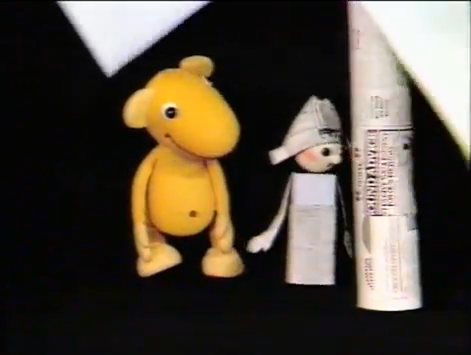
The first production from Pullover Productions (who later made Fox Tales), Pullover was a 1982 show created by Rosta Cerny and Susan Kodicek and broadcast by ITV. The show was backed by ITC entertainment and made at Kadek Vision - a long defunct company based at Shepperton Studios. The lively music score was composed by Eugen Illin, who also composed music for German TV's translation of the 'fuzzy felt' Moomins series. The one human star of the show was the child (Danny Kodicek), who just happened to be the son of Susan Kodicek. There was one series of 13 episodes produced and they utilised Cerny and Kodicek's trademark black light theatre approach.

Pullover examined that terrible ordeal where children have to go to bed. Sure, you've got the escapism of dreams to look forward to, but there's also the feeling of injustice. Why should the adults get to stay up and have all the fun watching fledgling police dramas such as The Bill? Children need to learn about limits, though, so they'll just have to go to bed when they're told. Once they become adults they can flout the rules all they want and turn up to work after 3 hours sleep and unshaven. Thankfully, for the child in Pullover, his mother has attempted to reduce his ire by taking his pullover and making a few changes to produce Pullover - a cute little animal who is part bear, part something else. Oh and he's yellow. Pullover magically comes to life each night, when the child is asleep. Creeping down from the bedpost, Pullover tends to find something intriguing in the child's bedroom which leads to an adventure - be it a balloon which transports Pullover up into the clouds or a toy penguin which takes him to the Antarctic.


Pullover was a little before our television viewing period started, so we weren't even aware of the show until we started researching for Fox Tales. As that particular show was something which had kept our interest, despite not viewing it for 25 years, we thought that another Cerny/Kodicek show was definitely worth a peek. And we weren't disappointed.

Pullover performs a neat trick by taking its viewers into a wonder filled world which taps deep into the core of children's imaginations. When Pullover is seen floating up into the sky and perching upon a cloud, he's performing one of those dreams which every small child has. Equally enthralling is Pullover's descent from the cloud-world which sees him sliding down a rainbow. I don't know about you, but seeing a rainbow as a child always stopped us dead in our tracks. It's little tricks like this that captivate your attention and leave you waiting for Pullover's next curious adventure in his fantastical world.


The puppetry on display is excellent and feels more polished than that on offer in Fox Tales. The black light theatre aspect breathes life into the puppets, whilst the control and choreography of the puppets is really special - see the scene set at sea in the 'China' episode for the fantastic heights Cerny/Kodicek could reach. Being aimed at the preschoolers means that the characters all have a cutesy look to them. Some time and effort has gone into creating them and they help to make their little universe quite mesmerising. As a result of the series, there was an official knitting pattern released by the company Robin so that a Pullover toy could be created.

Another mesmerising aspect is the music provided by Eugen Illin. It's a sprightly, jazzy affair involving xylophones, wind instruments, a glockenspiel (perhaps) and several other instruments in  the mix. As there's very little speech in the programme - apart from the child at the start - the music is utilised to help reflect the mood of the story. It does this effectively and creates a dreamy soundscape for the characters to inhabit.


All in all, the rather simple stories blend together great aspects to make a very watchable children's show. We're at a loss as to why the show wasn't repeated more often or ever granted a commercial release. Eight of the episodes have been uploaded to Danny Kodicek's YouTube page and we can't recommend heading over there enough to investigate this curious show.

MISC

We've got hold of a copy of the official knitting pattern to 'make' a Pullover - see below! If you want scans of the full instructions, then get in touch and we'll email over the rest!


Thursday, 6 June 2013

Scragtag and his Tea Time Telly


Genre: Childrens
Channel: BBC1
Transmission: T.T.V: 31/10/1985 - 25/04/1985. Scragtag: 18/09/1986 - 18/12/1986


Some cats you want to sit on your lap and purr approvingly as you slurp a cup of tea and watch telly. Other cats you physically cross the road from just in case you catch something - you know the types, the scraggly looking ones who are most at home when they're rummaging through a bin. You wouldn't think they'd make a great children's TV host, but it turns out Scragtag wasn't too revolting.