Genre: Comedy
Channel: BBC2
Transmission: 01/02/1991 - 08/03/1991
It only takes a cursory look at the Saturday night television listings to see that crime is all too prevalent in the modern age. The horror of these heinous Ant and Dec fuelled misdemeanours makes you hark back to a simpler era such as the early 90s. Ah yes, a wonderful, more innocent age where you could leave your TV on with nothing more than the threat of PJ and Duncan yapping away about the theft of Geoff's beard by Denton Burn. Look a little closer, though, and you'll realise that this period had more than its fair share of televisual crime - see the front row of any Top of the Pops audience circa 1991. Luckily, for the viewing public, on hand in this particular day and age were the crime fighting duo of Lazarus and Dingwall.
Lazarus (Stephen Frost) and Dingwall (Mark Arden) are policeman working together for the Really Serious Crimes Squad. Their struggles with the criminal underbelly include such intriguing cases as investigating the murder of a stuntman, trying to track down the pushers of a shipment of cocaine that's turned up in a batch of Colombian cod and a bizarre art installation involving a corpse. Heading up the Really Serious Crimes Squad is the microwave meal loving, part time cinema attendant Chief (Peter Bland). Other colleagues include department git Gary Bateman (Jeremy Gittins), Dingwall's desk based love interest of Beverley Armitage (Race Davies) and two incredibly boring plain clothes detectives (Simon Godley and Neil Mullarkey).
Six episodes of Lazarus and Dingwall aired on Friday evenings in early 1991 on BBC2. The series was written by Kim Fuller (brother of pop impresario Simon) and Victoria Pile along with contributions from Frost and Arden. Comedy legend Geoff Posner directed the pilot episode whilst the rest of the series was directed by the equally legendary Bob Spiers. The series was repeated in the very early years of UK Gold, but hasn't been seen since. No official DVD release has ever emerged, but a DVD copy of the UK Gold broadcasts is available on the black market.
Despite being well into our appreciation of British comedy by 1991, Lazarus and Dingwall completely passed us by at the time. Although we hadn't been exposed to much Frost and Arden we always enjoyed their brief appearances in Blackadder, The Young Ones, the Carling Black Label adverts and The Estate Agents. With a well honed chemistry between the pair we were curious about how they would fare at the forefront of a show. YouTube yielded little more than a few brief clips and the titles, but one of our shady contacts managed to get the series in our grubby hands fairly sharpish.
The humour's great. Very deadpan, packed full of visual gags and a blatant graduate from the Zucker-Abrahams-Zucker school of comedy. As with Police Squad, this type of humour sometimes gets in the way of any real emotional depth, but it's so playfully silly that we don't care. Every episode bristles with sharp, irreverent dialogue that helps matters unfold at a brisk pace.
The writers don't fare so well with the plots. They're given sublimely ridiculous frameworks to hang on, but at times it seems the writers are concentrating more on the gags than the story. It's a minor quibble for us, but some more advanced plots and well integrated subplots really could have pushed the series further. You only have to take a look at how well A Touch of Cloth, although slightly different in format, pulls off gag after gag coupled with strong, dramatic plots.
As mentioned previously, Frost and Arden are very comfortable playing off each other and the chemistry is refined to perfection. The deadpan nature of the scripts plays to their strengths, so their performances are more than enough to carry the weight of the show. Lazarus and Dingwall was Frost and Arden's big chance to start carving out starring roles for the duo, but sadly this was the only show they ever helmed. The rest of the acting on show is ok, you know, nothing too spectacular, but there's some nice turns from Lionel Blair and Stanley Unwin to liven up proceedings.
Lazarus and Dingwall is a light, knockabout gag packed show which deserved a second series. There was definitely more mileage in the characters and, perhaps, a second series could have mined their back stories further. As it is, we're left with a show that, whilst not taking you on an emotional rollercoaster, will remind that sometimes a bit of silliness is all we need.
Sunday, 28 September 2014
Wednesday, 17 September 2014
The Children of Green Knowe
Genre: Childrens
Channel: BBC1
Transmission: 26/11/1986 - 17/12/1986
The last thing that we wanted to do as a child was be confronted by several ghosts. A box full of He-Man figures, yes, a gang of ghostly children - all slaughtered by the Great Plague - definitely not. However, some kids are pretty lonely. Take, for example, that kid, there's one in every town, whose only friend is a half eaten stickle brick. That kid would kill for some real friends, even if they are a little corpsey. Yep, that kid is pretty easy when it comes to friends. Even if, for good measure, there's an age old curse attached as in The Children of Green Knowe.
In a boarding school somewhere in post-war Britain, the ridiculously named Toseland (Alec Christie) or, as he prefers to be known, Tolly (little better), has receive word from his Father that he will be spending Christmas with his maternal Great Grandmother known as Mrs Oldknow (Daphne Oxenford). Tolly's festive home will be the ancient Oldknow family home of Green Knowe. Within the confines of Green Knowe, Mrs Oldknow regales Tolly with the stories of years past. Oh and, after laborious scenes of hide-and-seek, he makes pals with his long dead relations Toby (Graham McGrath), Alexander (James Trevelyan) and Linnet (Polly Maberly). It's not all fun and games, though, as the ancient tree-spirit Green Noah is intent on getting his branches on Tolly.
Based on the Green Knowe series of books by Lucy M Boston, The Children of Green Knowe was dramatised by John Stadelman for BBC1 in 1986. The serial consisted of four episodes and aired on Wednesdays at 5pm as part of the CBBC schedule. Colin Cant, who had previously directed The Machine Gunners and Grange Hill, directed the show whilst the soundtrack was provided by Peter Howell of the BBC Radiophonic Workshop. No commercial release has ever emerged, but the series has been uploaded to YouTube.
The Children of Green Knowe is in the same vein as other BBC telefantasies The Box of Delights and The Chronicles of Narnia, so you know what to expect - well spoken children, a bit of magic, some horror and a wonderful soundtrack. The Children of Green Knowe isn't as well remembered as the aforementioned shows, but it certainly gives a good stab at staking its claim.
Alec Christie and Daphne Oxenford deliver good performances and Christie, in particular, manages to avoid the horror of 1980s wooden acting. The chemistry between the two is also very convincing which makes for an engaging piece of television. George Malpas, who pops up intermittently as the groundskeeper Boggis, inhabits his character well with all the nuances of a man skilled in the ways of the country. The spectral trio of Tolly's ancestors aren't particularly convincing, but Polly Maberly has gone on to carve out a successful career on the small screen - proof that actors continue developing long after 9 years of age.
Now, the main problem we had was the story. Granted, there are some wonderful scenes created by the inter-character dimensions and, sure, there's some interesting concepts of stability, ancestry and nature. Further yet, there's also some creepy scenes as Tolly searches frantically for answers within the house and the grounds. But, and this is a big but, there's barely any plot there. Granny tells a story, Tolly considers the story and then runs round whining that his ghostly chums won't show themselves. The only antagonist present is Green Noah and he barely makes his presence felt until the last episode. The serial is relying on material from the book, but a bit of artistic license to create more jeopardy for Tolly could have done wonders.
So, due to the lack of true adventure and battle, we're going to label The Children of Green Knowe as a missed opportunity. However, don't go thinking that this isn't a show worth revisiting. At four episodes long it manages to avoid boring the viewer inside out - we struggle to see how they could have stretched it any further, so kudos for the production team on that. The BBC always do a great job with period dramas and The Children of Green Knowe is no exception. It conjures up a show which is eminently watchable, cosy and just perfect for a quick spot of festive viewing. And it's certainly more entertaining than a half eaten stickle brick.
Friday, 12 September 2014
Round the Bend
Genre: Childrens
Channel: ITV
Transmission: 1989 - 1991
Little Johnny burrows into his nose with an eager finger as his other hand rummages deep into his pocket for Black Jacks engrained with dirt. His little sister, Jessica, enters and says "Oh, Johnny, you're such a frightful little urchin!". Johnny, finger still in nose and hand just millimetres away from the Black Jacks, burps in Jessica's face and shouts "EAT THAT BUM FACE!".
Howling in disgust, Jessica runs back to the sanctity of Polly Pocket and her Jason Donovan posters. Johnny is beside himself with laughter, so much so that he almost misses the ominous tones of his favourite TV show starting up. With Black Jacks, and goodness knows what else, in his gob he sits down to watch Round the Bend.
Deep Down in the Sewer
Doc Croc - yep, he's a crocodile - helmed Round the Bend which took pop shots at the inanity of magazine shows for children. Eschewing the bright and cheerful sets of Going Live et al, Round the Bend settled for a dirty, dank and dingy sewer! This is where Doc Croc found himself introducing a myriad of absurd and crude animations which teach children that they have a right to mock the world they live in.
Move over boring old He-Man and, instead, welcome in 'Wee-Man and the Masters of the Looniverse'! Assisting Doc Croc in running the show were a group of rats - posh reporter Jemimah Wellington-Green, optimistic and terrible comedian Vaudville Vince Vermin and, finally, whipping boy of Doc Croc, the artist Luchetti Bruchetti.
The Story behind the Bend
To find out how Round the Bend oozed it's way onto our screens we have to head back to the mid 1980s where Patrick Gallagher, Tony Husband and Mark Rodgers were trying to come up with a solution for a taxing problem. Viz had been a wild success for sniggering adults who were nothing but big kids at heart.
However, 'actual bona fide as per the trade description act' kids couldn't get hold of this top shelf laugh-a-thon for love nor money. Why the hell should they be missing out?! Well, apparently, the language was corruptive and sexual content was never far from it's pages or something whiny like that.
So, the only solution was to introduce a kid friendly version which trod the right side of offensive. And, hence, Oink was born! An anarchic comic far removed from the Beano with comic strips including Tom Thug, Horace 'Ugly Face' Watkins and Pete and his Pimple. After 68 controversial issues, Oink came to an end, but Messrs Gallagher, Husband and Rodgers were now ready to take their vision of adult humour for the kids to television.
Produced by Hat Trick productions for Yorkshire Television, Round the Bend managed 18 episodes over three series between 1989 - 1991. The puppets featured in the show were provided by the Spitting Image team and this is most evident in the three heads mounted on the wall.
Patrick Gallagher designed the puppets, sets, animations and anything else he could get his creative hands on. Along with Tony Husband and Mark Rodgers, Gallagher also helped to write the show. John Henderson - fresh from directing Spitting Image - took charge of the directing duties whilst the music was provided by Big George, Phillip Pope and Simon Franglen. Aardman Animations, who were beginning to gather steam with the launch of Wallace and Gromit, created animations for the show along with Catalyst Pictures.
Repeats followed on Nickelodeon, The Childrens Channel and Channel 4 (surely its spritual home), so the show found itself in high demand. It's success led to the ultimate honour of a quick cash in computer game adaptation. Released across a variety of formats in 1991 by Zeppelin Games, a quick look on YouTube shows the game to be a fiendishly difficult platformer. Frankly, if you can go 30 seconds without dying in it, then we doff our cap to you.
Re-venturing Round the Bend
Do we remember Round the Bend? Did Michael Barrymore star in Sebastian the Incredible Drawing Dog?! We loved Round the Bend! We tuned in religiously each week to laugh ourselves silly - Wee-Man instead of He-Man? We were literally rolling on the floor laughing.
The manic nature of the show and lack of anything serious appealed to our inner lunatic and we couldn't get enough. Asking our peers about the show, it seems to be one that some remember, but just as many don't. It was ripe for investigation by our curious eyes and, luckily, every single episode is up on Tony Husband's website.
So, how was it? Well it was good. It was funny. There are moments of utterly surreal genius such as 'False Teeth from the Stars' which is an amazing animation to be showing kids. It's a great way of exposing them to a sophisticated form of comedy without having to explain why it makes them convulse with laughter.
It's not just genres that come under Round the Bend's mocking glare either, individuals are targeted such as David Coleman and John Craven who are mercilessly lampooned. The viciously keen streak of satire and parody which rampages through Round the Bend marks it out as a unique slice of kids TV.
Some of the comic strips don't hit the target, so it's not hit after hit. However, the animations are all pretty nippy, so if you're not enjoying something you can rest assured that more laughs are just around the corner.
Doc Croc is a great host for the show and should be as well remembered as other animal hosts of the era e.g. Nobby the Sheep and Roland Rat, but perhaps his propensity for violence made him a bit too dangerous for some. We weren't overawed with the rat characters, so much, as Vince and Luchetti came across more irritating than entertaining, but Jemimah was a bit more interesting as her falls from grace were always satisfying.
Round the Bend is a show close to our hearts and it's a testament to the show's inspiring brilliance and manic energy that we remember it so vividly. Sure, some of the references are pretty dating and would leave kids of today scratching at their Joey Essex styled heads, but there's still plenty of timeless material in it. We still love it now and a part of us will forever be little Johnny trying to shock, outrage and defy people for nothing but our own amusement.
Saturday, 30 August 2014
Hokey Cokey
Genre: Childrens
Channel: BBC1
Transmission: 1983
Every little kid loves a song and particularly a song they can jive their tiny limbs to. If they don't, then there's something severely wrong with them and they're likely to end up packing jars of sauerkraut when they're older. And not just for a living, but for a hobby as well. We avoided these vile creatures at our playgroup and spent most of our time dancing the Hokey Cokey.
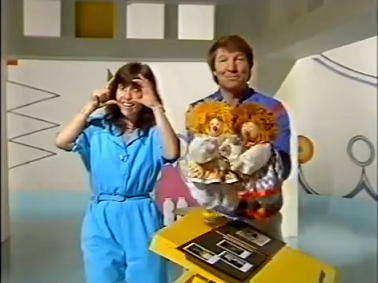
Hokey Cokey, right, it's a show about... well... there's two puppets, ok? Hokey and Cokey. They're operated by Don (Don Spencer) who likes to break into song every 30 seconds or so. He's an Australian too. There's also Chloe (Chloe Ashcroft) who is equally prone to breaking into song. She's English and rocks some amazing 80s jumpsuits. Carol (Carol Chell) also starred and, although we haven't seen any of her footage, we reckon she's up for a song or two. So, these songs, what are they about? Well, they have a strong footing in the realm of nonsense such as "Hooray for Eyes" song and the "Old Woman Tossed Up In a Basket" song. Some episodes have a strong consistent theme e.g. the 'Space' episode, but some episodes seem to be a nonstop jumble of songs, stories and animation e.g. the 'Cameras and Jungle' episode.
Another glorious chapter in the history of the See-Saw programming for children on the BBC, Hokey Cokey first aired in October 1983 and consisted of 26x 15 minute installments. The show was very much a cousin of Play School which starred both Spencer and Ashcroft. Executive producer for Hokey Cokey was Cynthia Felgate who also happened to be part of the crew behind Play Away (a sort of cousin-twice-removed of Hokey Cokey) which also featured Ashcroft.
The show was such a monster success at the time that it resulted in a record being released. Pretty swish, don't you think? Just imagine getting a few friends round, cracking open a bottle of spiced rum and dancing like a pirate to this! If only our record player hadn't been confiscated by the police after we played that Camberwick Green record at 78 rpm for 3 weeks...
The name Hokey Cokey kicked off a series of nostalgic happenings deep within our brain. The opening credits - some kids mucking about on an estate playground in London - further chimed with our subconscious, but we couldn't remember anything else. YouTube yielded two episodes, so we settled in for half an hour and got our viewing glasses (our eyes) on.
The sets are very cheap and point to a shoestring budget which was commonplace for children's television back in the 80s. We suspect the Playschool studio was quickly redressed to accommodate Hokey Cokey, but it doesn't really affect the show thanks to the rich and bewildering content taking place up front.
Don Spencer is absolutely fantastic in this and his antipodean confidence is a refreshing change from the era's standard avuncular male lead. His persona is an intriguing one as he looks completely comfortable with two frilly clown puppets attached to his arms, but you also wouldn't want to spill his pint of Castlemaine XXXX. A proven musician, Hokey Cokey is the perfect vehicle for Don and he takes it all in his stride. Chloe Ashcroft comes across as a slightly unhinged primary school teacher with her wide eyes and willingness to embrace the songs with a nice line in barmy interpretative dance skills.
As mentioned earlier, some episodes seem to be a mash up of ideas and material which point to a particulary strong vein of the avant-garde running through the show. Either that or they were pushed for time. It's an exciting approach though and ensures the show never drags - if you get bored by one section, you know something new will be along in two shakes of a tail. The space episode is more consistent, but no less entertaining with plenty of cutting from scene to scene.
And did we mention that there's even some basic chromakey action going on? Check it out in the 'Cameras and Jungle' episode. You'll be amazed that it had reached children's tv at this point. A whole 4 years before Knightmare went psychotic for it.
It's difficult to dislike Hokey Cokey as there's such a variety of ideas crammed into 15 minutes on such a tiny budget. The performers help make the show with their supreme confidence and appear very comfortable with material that could easily fluster someone less talented. We'd love to see more episodes and, in particular, some that feature Carol Chell to see how she compares. Hokey Cokey, then, is a show which deserves a little more recognition in the pantheon of classic children's TV.
Saturday, 26 July 2014
No - That's Me Over Here!
Genre: Sitcom
Channel: ITV
Transmission: 1967 - 1970
Ah! The office! What a wonderful environment to indulge in a spot of reckless backstabbing! How else are you going to climb the ladder, get the company car and then take that busty, low top wearing secretary on a "business trip" to Monte Carlo? You'd never catch this sort of behaviour going on in the Curious British Telly office, of course, but that's only because we can't afford a secretary. A much better example of this competitive and ambitious rivalry can be analysed in the guise of No - That's Me Over Here!
Office Life
City Life & Fire Insurance Co. Ltd is home to suburban commuter Ronnie Corbett (Ronnie Corbett!) who is an aspirational chap keen on impressing the boss, Mr Robinson (Ivor Dean). Cyril (Henry McGee) works in Ronnie's department, shares the same commute to work every morning and finds himself living as Ronnie's neighbour. Frankly, he's sick of Ronnie, so does his best to come up with dastardly schemes to hoist Ronnie with his own petard and take all the glory for himself.
A Magnificent Team
The year is 1967 and Britain's funny bone is being mercilessly tickled by a burgeoning comedy boom. David Frost, suitably impressed with the success of The Frost Report, now has his sights set on the world of sitcom.
Convening under the careful watch of his executive producer's eye are Graham Chapman, Barry Cryer and Eric Idle - all fresh from working on The Frost Report. Together they've crafted an idea involving a man with high aspirations working in an insurance office. David Frost brings in another alumni of The Frost Report in the guise of Ronnie Corbett, as the show's leading man, and Associated-Rediffusion have no option but to bite their hands off.
No - That's Me Over Here! notched up three series between 1967 - 1970 on ITV. The first two series were recorded in black and white and produced by ITV contractor Associated-Rediffusion. Legend has it that the first two series are consigned to the wilderness of missing episodes. However, Curious British Telly got hold of one of these episodes fairly easily, so the true archival status of the first two series is a little murky.
For the final series, which went out in colour, the series was produced by LWT, a move precipitated by David Frost setting up home there. This series finally received a DVD release in 2015.
Oh and Eric Idle buggered off after the first series. God knows whatever became of him.
Ah, There You Are!
Curious British Telly grew up watching The Two Ronnies and Sorry, so we've always had a soft spot for Ronnie Corbett. Once we discovered there was a barely remembered sitcom featuring him with a couple of Pythons involved, we had no choice but to take a look. There were a few little snippets here and there on the net, the occasional screenshot, but not much else.
A public appeal was launched for help in tracking down some episodes and, in next to no time, someone had kindly contacted us to offer two episodes. And, good heavens, one of the episodes was in black and white! And from the 60s! A double first for Curious British Telly!
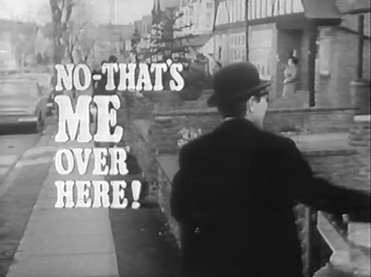
Ronnie Corbett, not surprisingly, won very few, if any, Best Actor awards, but he was an immensably likeable chap whose smile was beloved by grannies, small children and those irritating tossers in pubs who eulogise about the Four Candles sketch. In No - That's Me Over Here! you can tell he's giving it all in his first leading role and he conjures up some fine moments of physical comedy.
Our favourite performance in the series, though, is from Henry McGee who personifies the Great British Cad with moustache twiddling ease. Sadly, the rest of the actors lack any real vigour and are nothing more than stereotypical sitcom performances, but this would hardly be the first sitcom from this era to suffer from poorly written characters.
The plots, well, they're an incredible distillation of everything that was funny in the 60s and early 70s. Gents wearing bowler hats, keeping up with the Joneses in Suburbia and a hint of xenophobia.
Take the black and white episode we watched, the plot essentially boils down to this: Ronnie has invited his boss round to dinner in order to get a promotion that Cyril also wants. Ronnie's boss, of course, fought in World War 2. Ronnie's wife, therefore, just happens to have invited Jurgen round for dinner the same night. Jurgen is German. Ronnie pretends Jurgen is Swiss. Cyril pops round to meddle. It could only get more cliché if a vicar walked in, his trousers fell down and his groin had been replaced with Marty Feldman's face. Feldman was actually involved, but purely in a producers role.
The colour episode we watched wasn't quite as predictable and there were a couple of great scenes which featured Ronnie going to extreme lengths to retrieve a letter of resignation he had been tricked into handing in. On the whole, though, the laughs were sparse and the action rather lacklustre. Matters aren't helped by poorly developed characters who have only a few interesting facets stapled onto willing actors. A bit more time spent on the characters' hopes, wants and needs rather than just skimming the surface could have made for something more rounded that viewers could invest in.
Final Thoughts
No - That's Me Over Here! was a fairly disappointing watch and, even though it managed three series, we're not surprised it's barely remembered by the British public. The content simply isn't rich enough and we couldn't engage with the show in the way that, all these years later, we still do with Til Death Us Do Part, Steptoe and Son and Dad's Army.
People look back at 60s and 70s comedy with rose tinted glasses, but for every classic sitcom there were plenty of middling, uninspiring sitcoms such as No - That's Me Over Here! We'd probably watch a few more episodes out of sheer curiousity, but we won't be travelling the globe in search of them.
Thursday, 19 June 2014
Agent Z and the Penguin from Mars
Genre: Childrens
Channel: BBC
Transmission: 03/01/1996 - 07/02/1996
Every schoolkid - at least every schoolboy, God knows what girls get up to at that age - loves to play a prank and laugh at their victim's horrified face. On the face of it, it's bullying, but if you can justify the jest you avoid the smear of being a mean rascal. It's where every comedian starts off in life. Probably. We can certainly imagine a fledgling Johnny Vegas tar and feathering his Aunt for example. Anyway, yes, PRANKS! The BBC decided this would be the perfect way to engage with the mid 90s youth, but didn't want to tit about with buckets of waters being balanced precariously atop doors. No, they wanted to go much bigger, so commissioned an adaptation of Agent Z and the Penguin from Mars.
The Crane Grove Gang is a collective of youngsters comprised of Ben Simpson (Duncan Barton), Barney (Andrew McKay) and Jenks (Reggie Yates) who just happen to live on Crane Grove. This isn't the only alias they operate under though, the pranking wing of their enterprise is known as Agent Z. The gang are happily pranking the public with ventures such as dressing up as a gorilla on the loose when Ben finds himself with a new set of neighbours - The Sidebottoms, headed up by lottery winner Dennis (Rod Culbertson) with his wife Patricia (Pamela Power) and kids Tod (Andrew Wheeler) and Samantha (Nicola Mycroft).
Ben attempts to take Tod under his wing, but soon discovers that Tod is a sneaky, little rat who manages to portray himself as the perfect son to his parents. After Tod is caught shoplifting a Dolly Parton CD, Dennis pins the blame on Ben and threatens to make his life very difficult. Agent Z is called into action with their biggest prank yet, one which aims to exploit Dennis' love of astronomy and a penguin 'borrowed' from the local shopping centre.
Agent Z and the Penguin from Mars was a 1996 adaptation of Mark Haddon's novel of the same name. It aired on BBC1 on Wednesdays under the CBBC umbrella and was script edited by Marilyn Fox, a talented individual who has popped up on our blog countless times. The series was never repeated and no more of Haddon's Agent Z novels were adapted for TV. YouTube currently houses the entire serial for those looking to relive the adventure.
Curious British Telly eagerly tuned in to Agent Z each week back in those short winter days of 1996 and really connected with it. We were roughly the same age as the protagonists and the world of elaborate pranks really caught our imagination - a prank for us usually revolved around a fake dog turd being chucked at one of our mates. One reason that Agent Z always stuck in our mind was due to us being inspired to start writing a book about 3 pranksters - all we remember was coming up with some mundane plots e.g. one plot was that one of them had gone on holiday to the Norfolk coast, so the other two had to do pranks on their own. We didn't get very far with writing it. Maybe a page. It was a strange age where we were on the cusp of wanting to investigate more adult pursuits, but still intrigued by schoolboy japes. Would the series hold up to our mature eyes of 2014?!
First off, Reggie Yates?! Reggie Yates was a thing back then? We had no idea he had starred in this. He doesn't make too much of an impression here, he's mostly used for comic relief. We remember connecting with Duncan Barton's Ben character at the time, probably because he personified the average 12/13 year old with hints of anxiety and vulnerability. However, this time round, we found him a little sappy at times. Barney's character was much more appealing this time round with his cocksure and cheeky attitude. We'd want to be Barney now. You just know he's going to grow up and get the ladies.
Rod Culbertson gives one of the best performances in the series as Dennis as he captures the arrogant father with perfect menace. Andrew Wheeler as Tod isn't a great actor, but his weasel-like ways left us wanting to punch him up the bracket, so he achieved his characters aim. Final mention goes to Ian Sharrock as Ben's father, Trevor, who we recognised as Jed Maxwell from I'm Alan Partridge. He plays a likeable, nice guy Dad and we're surprised that his acting career ground to a halt just a few years later.
The story ticks along nicely and the plot builds nicely as - despite the big set piece half way through the series - the situation takes more and more absurd turns. The production team are helped by the magic touch of Marilyn Fox and also the talented storytelling of Mark Haddon which has seen him go on to win numerous awards including the Whitbread Award. We were a little annoyed that Tod disappears for nearly two episodes as he's such a deceptive little worm that he makes a great antagonist. There's also a half started plot revolving around a potential romance between Ben and Samantha Sidebottom, but this seems to evaporate fairly early on when it could have helped increase the tension between Ben and Dennis.
The series has a satisfying end and we enjoyed rewatching it nearly 20 years on from transmission. It's got a snappy feel to proceedings although a lot of the jokes fall flat. Ultimately, though, it takes us back to the days of being part of a gang messing about, years before the allure of women and alcohol took over our interests. It is, of course, also incredibly 90s with it's god-awful waistcoats, Wonderwall playing in HMV and Ben's Zig and Zag bedspread. It's a pity that no more series' followed as it's a likeable show if not a stone cold classic.
Saturday, 19 April 2014
The Blunders
Genre: Childrens
Channel: ITV
Transmission: 1986 - 87
Life is often little more than a series of blunders. They're rather inconvenient, but from these blunders we can learn and modify our future behaviour to make life less troublesome. TV executives are certainly not immune to making gaffes - some even appear to have made a career from it - but what would they learn from The Blunders?
The Blunder family (Ma Blunder, Pa Blunder, Bobby Blunder, Baby Blunder, Zebra the cat, Trouble the dog and Patch the Bird) all live in bungled harmony in the curiously named town of Villa Shambles. They blunder here, they blunder there and more often than not they bugger things up. The other inhabitants of Villa Shambles tend to shudder at the sight of the Blunder family and wildly scratch at their sides to remove the metaphorical thorn that they are.
The Blunders was an animated offering by the legendary talents of children's TV known as FilmFair in conjunction with Central Television. 30 five-minute episodes aired on ITV between 1986 - 87 and all the voices were provided by that British institution known as Frankie Howerd. Wonderfully named duo Colin Voisey and Haydn Moran created the Blunder family and Ian Sachs was on hand to write the episodes. The animation was completed by Geoff Loynes whilst the artists on hand were Alison Johnston, Theresa Whatley and Deborah Johnson. The theme tune and lyrics was the result of a collaboration between Chris Stuart and Robin Lyons. Both Castle Vision and Thorn EMI Video released VHS releases.
We were trawling through a long list of children's TV shows when we happened upon The Blunders. Despite it airing when we were a cognisant child, the name rang no bells with us. A few tiny mentions of it popped up online, but no more than that and no one we spoke to had heard of it either. We discovered that it featured Frankie Howerd and this intrigued us as he had the perfect voice for children's TV. YouTube yielded no footage, but luckily, we found a shady site selling 10 episodes on DVD (presumably cribbed from one of the VHS releases), so soon had the show in our grasps.
Frankly, The Blunders is nothing short of a disaster. It start wells with the zingy, brass filled theme tune and Frankie Howerd's delivery of the lyrics is pitch perfect, but then it's all downhill.
The animation is well below par from FilmFair. Can you remember those adverts in the backs of magazines which promised to turn you into a cartoonist? You'd send off a cheque (or postal order) and receive a handmade booklet taking you through the basics of drawing cartoons. Friends and family would marvel at your 'rushing man' and 'wiseass bunny' whilst proclaiming that "Walt Disney better watch out as Colin Fletcher is now in town!". In reality, they were generic, characterless sketches with no soul and The Blunders is no better.
Perhaps we would forgive the amateur level of animation if the stories and gags were of such a high calibre that grown playwrights would openly weep, but, nah, plenty of dry eyes in the house. For a comedy show to work you need a little blundering, but not non-stop blundering which irritates the viewer. There's no skilled imagination trying to craft warm and witty tales here. Instead, there's just a load of titting about from characters we want to slap round the face.
Why on Earth Central Television commissioned thirty episodes of this diabolical mess is utterly beyond us. We try to find positives in most shows we look back at, but all this show did was annoy us that we'd wasted several quid on it. Still, reviewing the hidden depths of British TV was never going to be pretty. The one good thing with The Blunders is that a TV executive looked at the blunder of commisioning this show and learnt what a catastrophe it was, so a second series never appeared. Our opinion is: AVOID!
.
Saturday, 22 March 2014
Galloping Galaxies
Genre: Childrens
Channel: BBC1
Transmission: 01/10/1985 - 29/10/1985 & 21/11/1986 - 18/12/1986
"Great galloping galaxies!" is a piece of dialogue in the mathematical sociology novel 'Foundation' by Isaac Asimov. It's a gripping story about... uh... long division ASBOs? Maybe? Frankly, we're not too bothered as we aren't a damn retro book blog, we're a God damn retro telly blog! Much more gripping to us, and you, is the sci-fi comedy romp entitled Galloping Galaxies.
It's the year 2487 and the crew of the merchant spaceship Voyager are hurtling through space led by Captain Pettifer (Robert Swales). Making up his crew are First Office Morton (Paul Wilce) and Second Officer Elliott (James Mansfield). They're also aided and abetted by the ship's bog eyed computer SID aka Super Intelligent Deducer (Kenneth Williams).
Life in outer space is never easy and the crew experience troubles such as mistakenly beaming aboard Miss Appleby (Priscilla Morgan) from the 20th century. Trying to put a spanner in the crew's works are the robot pirates Paddy O'Twenty/Robot 20 (Matthew Sim) and Sean O'Seven/Robot 7 (Michael Deeks) who are put to task by their pirate chief Mick Murphy (Sean Caffrey/Niall Buggy).
Galloping Galaxies first warped into view with 5 episodes in 1985 and a second series followed in 1986 with another 5 tales of space adventures. These futuristic visions of space dystopia were dreamt up by Bob Block who was otherwise known as "that geezer behind Pardon My Genie and Rentaghost". Jeremy Swan - who had previously directed Rentaghost - was entrusted with recreating Block's vision for the BBC. A novelisation of the first series was released by Target in 1987 and the second series was due to follow in book form, but this never materialised. No commercial release of Galloping Galaxies has ever appeared. The first series was repeated between August - September 1987 and a repeat of the second series aired in the same slot a year later.
Galloping Galaxies was a year or so too early for us. We were watching television in 1985, but were probably in bed when the show aired. Or refusing to eat greens. Until we have time travel technology we can't pinpoint our exact TV habits. Anyway, we first heard about the series during a Twitter love-in about forgotten shows. It appealed to us primarily as it's sci-fi and that it was one of Kenneth Williams' final roles.Anyway, episode two of series one is up on YouTube (just about watchable), but we didn't want to charge in halfcocked. To help get a handle on the show, we took a trip down to the BFI Archive to watch episode one first.
You know what? We really loved Galloping Galaxies. It's like some freewheeling cocktail expert has grabbed his cobbler shaker, chucked in a couple of shots of Douglas Adams, squeezed in a dash of Carry On and garnished with some terrible special effects. It's the vodka martini to our James Bond of retro telly investigation.
The gags are sharply written and neither condescending or childish - this is good as it means we don't feel ridiculous watching a kids show. Kenneth Williams' vocal strengths are used to their full potential and there's even room for some double entendres e.g. Morton starts rooting around in SID's circuitry prompting SID to cry "Oooh! Here, take your hands off my floppy discs!". A very British vein of humour runs throughout from Miss Appleby's middle class preoccupations to the foolish Irish robots. Bob Block - who is sadly no longer with us - gets a 21 cannon salute from us for his hilarious scripts.
Performances didn't disappoint and we were rather bemused that barely any of the cast went on to carve out a career. The performances of Robot 7 and Robot 20 are zingy affairs and they're surely the prototypes for Jedward - sadly, lessons were not learnt and their spiritual heirs continue to pop up on our screeens. Robert Swales puts in a commanding role as the suave Pettifer and the rest of his crew work well around him. It's a great cast which really lift it above other wooden fare from the same era.
The internal sets for are actually pretty good. They're simple, but colourful and haven't dated terribly. The special effects, on the other hand, appear to be stuck in the 1970s - namely Revenge of the Cybermen. What else, though, can you expect from a cash strapped children's department in the 80s? It's not going to be Blade Runner, but surely there must have been enough bits and pieces left over from Doctor Who to make the space scenes a bit more visually appealing.
We've only seen 2 episodes, so there's another 8 for us to watch and we already feel like we're going cold turkey. The only guaranteed fix for our addiction is a marathon viewing session at the BFI Archive. It's a rather expensive proposal though, so we fear we may end up resorting to petty crime to fund our habit. Of course, if anyone out there has access to any other episodes, then get in touch as we do have some moneys! In the mean time, we'll just have to dine on memories of a wonderfully pitched show packed full of laughs and decent performances.
INTERVIEW
You may be asking yourself what the original working title of Galloping Galaxies was, so why not read our interview with director, Jeremy Swan, to find out a bit more about the show!
PRESS CUTTINGS
Radio Times 28th September - 4th October 1985 pg.86
Glasgow Herald - 19th December 1986 pg.32
Channel: BBC1
Transmission: 01/10/1985 - 29/10/1985 & 21/11/1986 - 18/12/1986
"Great galloping galaxies!" is a piece of dialogue in the mathematical sociology novel 'Foundation' by Isaac Asimov. It's a gripping story about... uh... long division ASBOs? Maybe? Frankly, we're not too bothered as we aren't a damn retro book blog, we're a God damn retro telly blog! Much more gripping to us, and you, is the sci-fi comedy romp entitled Galloping Galaxies.
It's the year 2487 and the crew of the merchant spaceship Voyager are hurtling through space led by Captain Pettifer (Robert Swales). Making up his crew are First Office Morton (Paul Wilce) and Second Officer Elliott (James Mansfield). They're also aided and abetted by the ship's bog eyed computer SID aka Super Intelligent Deducer (Kenneth Williams).
Life in outer space is never easy and the crew experience troubles such as mistakenly beaming aboard Miss Appleby (Priscilla Morgan) from the 20th century. Trying to put a spanner in the crew's works are the robot pirates Paddy O'Twenty/Robot 20 (Matthew Sim) and Sean O'Seven/Robot 7 (Michael Deeks) who are put to task by their pirate chief Mick Murphy (Sean Caffrey/Niall Buggy).
Galloping Galaxies first warped into view with 5 episodes in 1985 and a second series followed in 1986 with another 5 tales of space adventures. These futuristic visions of space dystopia were dreamt up by Bob Block who was otherwise known as "that geezer behind Pardon My Genie and Rentaghost". Jeremy Swan - who had previously directed Rentaghost - was entrusted with recreating Block's vision for the BBC. A novelisation of the first series was released by Target in 1987 and the second series was due to follow in book form, but this never materialised. No commercial release of Galloping Galaxies has ever appeared. The first series was repeated between August - September 1987 and a repeat of the second series aired in the same slot a year later.
Galloping Galaxies was a year or so too early for us. We were watching television in 1985, but were probably in bed when the show aired. Or refusing to eat greens. Until we have time travel technology we can't pinpoint our exact TV habits. Anyway, we first heard about the series during a Twitter love-in about forgotten shows. It appealed to us primarily as it's sci-fi and that it was one of Kenneth Williams' final roles.Anyway, episode two of series one is up on YouTube (just about watchable), but we didn't want to charge in halfcocked. To help get a handle on the show, we took a trip down to the BFI Archive to watch episode one first.
You know what? We really loved Galloping Galaxies. It's like some freewheeling cocktail expert has grabbed his cobbler shaker, chucked in a couple of shots of Douglas Adams, squeezed in a dash of Carry On and garnished with some terrible special effects. It's the vodka martini to our James Bond of retro telly investigation.
The gags are sharply written and neither condescending or childish - this is good as it means we don't feel ridiculous watching a kids show. Kenneth Williams' vocal strengths are used to their full potential and there's even room for some double entendres e.g. Morton starts rooting around in SID's circuitry prompting SID to cry "Oooh! Here, take your hands off my floppy discs!". A very British vein of humour runs throughout from Miss Appleby's middle class preoccupations to the foolish Irish robots. Bob Block - who is sadly no longer with us - gets a 21 cannon salute from us for his hilarious scripts.
Performances didn't disappoint and we were rather bemused that barely any of the cast went on to carve out a career. The performances of Robot 7 and Robot 20 are zingy affairs and they're surely the prototypes for Jedward - sadly, lessons were not learnt and their spiritual heirs continue to pop up on our screeens. Robert Swales puts in a commanding role as the suave Pettifer and the rest of his crew work well around him. It's a great cast which really lift it above other wooden fare from the same era.
The internal sets for are actually pretty good. They're simple, but colourful and haven't dated terribly. The special effects, on the other hand, appear to be stuck in the 1970s - namely Revenge of the Cybermen. What else, though, can you expect from a cash strapped children's department in the 80s? It's not going to be Blade Runner, but surely there must have been enough bits and pieces left over from Doctor Who to make the space scenes a bit more visually appealing.
We've only seen 2 episodes, so there's another 8 for us to watch and we already feel like we're going cold turkey. The only guaranteed fix for our addiction is a marathon viewing session at the BFI Archive. It's a rather expensive proposal though, so we fear we may end up resorting to petty crime to fund our habit. Of course, if anyone out there has access to any other episodes, then get in touch as we do have some moneys! In the mean time, we'll just have to dine on memories of a wonderfully pitched show packed full of laughs and decent performances.
INTERVIEW
You may be asking yourself what the original working title of Galloping Galaxies was, so why not read our interview with director, Jeremy Swan, to find out a bit more about the show!
CBT: Hello, Jeremy! Many thanks for sitting down for a quick
chat with us! What exactly are you up to these days?
Jeremy: These days I work mainly as a painter (pictures, not walls),
I write plays, one has been performed –
and within living memory I’ve directed a couple of episodes of SOOTY for ITV.
You’ve worked on iconic shows such as Sooty, Rentaghost
and Jackanory, but how did you get started in in the world of children’s
television?
I started in Children’s Television as the AFM (Assistant
Floor Manager) on JACKANORY in 1967 and eventually became a director of the
programme.
We mentioned Rentaghost just now, which was also a Bob
Block show, so is this what led to you getting involved in Galloping Galaxies?
Bob also wrote GRANDAD, starring Clive Dunn, which I produced and directed; and the BBC
greatly appreciated his unique talent – so any new writings from him were
encouraged. As with RENTAGHOST and GRANDAD, his latest scripts came into my section
of the department’s output – I had inherited this position from Paul Ciani – a
producer who had gone on a BBC attachment to Singapore.
What can you remember about the initial stages in getting
Galloping Galaxies off the ground?
Originally it was called WORLD’S APART. I thought that title
was too documentary and a bit suggestive of some sinister late-night probe on
BBC2 ……. So I came up with GALLOPING GALAXIES! The initial scripts lacked a
central core and, after a visit to 2001, came up with a computer character.
Thank you, Stanley Kubrick! I’d done a lot of JACKANORYS with Kenneth Williams
so SID was a great excuse to work together again. And Miss Appleby was played by Priscilla
Morgan – Mrs Clive Dunn
We were really impressed with the quality of the scripts
and performances, but did everything run just as smoothly behind the camera?
Thank you – yes, it did.
The BBC were notoriously disapproving of children’s
sci-fi in the mid-80s with Doctor Who going on hiatus and The Tripods third
series being cancelled. Did Galloping Galaxies ever encounter any issues with
the powers that be?
No.
Kenneth Williams has been described as an incredibly
talented individual, but also a very complex and troubled soul. How did you
find working with him?
Terrific – and huge fun. The laughs!!
Were two series always the plan or was there a desire to
go on and do more?
No. Two series were fine.
One question we kept coming across when researching the
show was “Will it ever get a DVD release?!” Have you ever heard any murmurings
on the subject?
No.
Finally, when Jedward burst onto the scene a few years
back, did you think that Robot 7 and Robot 20 had been resurrected?
I hadn't... but now that you mention it...
Thanks for your time, Jeremy!
PRESS CUTTINGS
Radio Times 28th September - 4th October 1985 pg.86
Glasgow Herald - 19th December 1986 pg.32
Subscribe to:
Posts (Atom)