Genre: Childrens
Channel: ITV
Transmission: 1989 - 1991
Little Johnny burrows into his nose with an eager finger as his other hand rummages deep into his pocket for Black Jacks engrained with dirt. His little sister, Jessica, enters and says "Oh, Johnny, you're such a frightful little urchin!". Johnny, finger still in nose and hand just millimetres away from the Black Jacks, burps in Jessica's face and shouts "EAT THAT BUM FACE!".
Howling in disgust, Jessica runs back to the sanctity of Polly Pocket and her Jason Donovan posters. Johnny is beside himself with laughter, so much so that he almost misses the ominous tones of his favourite TV show starting up. With Black Jacks, and goodness knows what else, in his gob he sits down to watch Round the Bend.
Deep Down in the Sewer
Doc Croc - yep, he's a crocodile - helmed Round the Bend which took pop shots at the inanity of magazine shows for children. Eschewing the bright and cheerful sets of Going Live et al, Round the Bend settled for a dirty, dank and dingy sewer! This is where Doc Croc found himself introducing a myriad of absurd and crude animations which teach children that they have a right to mock the world they live in.
Move over boring old He-Man and, instead, welcome in 'Wee-Man and the Masters of the Looniverse'! Assisting Doc Croc in running the show were a group of rats - posh reporter Jemimah Wellington-Green, optimistic and terrible comedian Vaudville Vince Vermin and, finally, whipping boy of Doc Croc, the artist Luchetti Bruchetti.
The Story behind the Bend
To find out how Round the Bend oozed it's way onto our screens we have to head back to the mid 1980s where Patrick Gallagher, Tony Husband and Mark Rodgers were trying to come up with a solution for a taxing problem. Viz had been a wild success for sniggering adults who were nothing but big kids at heart.
However, 'actual bona fide as per the trade description act' kids couldn't get hold of this top shelf laugh-a-thon for love nor money. Why the hell should they be missing out?! Well, apparently, the language was corruptive and sexual content was never far from it's pages or something whiny like that.
So, the only solution was to introduce a kid friendly version which trod the right side of offensive. And, hence, Oink was born! An anarchic comic far removed from the Beano with comic strips including Tom Thug, Horace 'Ugly Face' Watkins and Pete and his Pimple. After 68 controversial issues, Oink came to an end, but Messrs Gallagher, Husband and Rodgers were now ready to take their vision of adult humour for the kids to television.
Produced by Hat Trick productions for Yorkshire Television, Round the Bend managed 18 episodes over three series between 1989 - 1991. The puppets featured in the show were provided by the Spitting Image team and this is most evident in the three heads mounted on the wall.
Patrick Gallagher designed the puppets, sets, animations and anything else he could get his creative hands on. Along with Tony Husband and Mark Rodgers, Gallagher also helped to write the show. John Henderson - fresh from directing Spitting Image - took charge of the directing duties whilst the music was provided by Big George, Phillip Pope and Simon Franglen. Aardman Animations, who were beginning to gather steam with the launch of Wallace and Gromit, created animations for the show along with Catalyst Pictures.
Repeats followed on Nickelodeon, The Childrens Channel and Channel 4 (surely its spritual home), so the show found itself in high demand. It's success led to the ultimate honour of a quick cash in computer game adaptation. Released across a variety of formats in 1991 by Zeppelin Games, a quick look on YouTube shows the game to be a fiendishly difficult platformer. Frankly, if you can go 30 seconds without dying in it, then we doff our cap to you.
Re-venturing Round the Bend
Do we remember Round the Bend? Did Michael Barrymore star in Sebastian the Incredible Drawing Dog?! We loved Round the Bend! We tuned in religiously each week to laugh ourselves silly - Wee-Man instead of He-Man? We were literally rolling on the floor laughing.
The manic nature of the show and lack of anything serious appealed to our inner lunatic and we couldn't get enough. Asking our peers about the show, it seems to be one that some remember, but just as many don't. It was ripe for investigation by our curious eyes and, luckily, every single episode is up on Tony Husband's website.
So, how was it? Well it was good. It was funny. There are moments of utterly surreal genius such as 'False Teeth from the Stars' which is an amazing animation to be showing kids. It's a great way of exposing them to a sophisticated form of comedy without having to explain why it makes them convulse with laughter.
It's not just genres that come under Round the Bend's mocking glare either, individuals are targeted such as David Coleman and John Craven who are mercilessly lampooned. The viciously keen streak of satire and parody which rampages through Round the Bend marks it out as a unique slice of kids TV.
Some of the comic strips don't hit the target, so it's not hit after hit. However, the animations are all pretty nippy, so if you're not enjoying something you can rest assured that more laughs are just around the corner.
Doc Croc is a great host for the show and should be as well remembered as other animal hosts of the era e.g. Nobby the Sheep and Roland Rat, but perhaps his propensity for violence made him a bit too dangerous for some. We weren't overawed with the rat characters, so much, as Vince and Luchetti came across more irritating than entertaining, but Jemimah was a bit more interesting as her falls from grace were always satisfying.
Round the Bend is a show close to our hearts and it's a testament to the show's inspiring brilliance and manic energy that we remember it so vividly. Sure, some of the references are pretty dating and would leave kids of today scratching at their Joey Essex styled heads, but there's still plenty of timeless material in it. We still love it now and a part of us will forever be little Johnny trying to shock, outrage and defy people for nothing but our own amusement.
Friday, 12 September 2014
Saturday, 30 August 2014
Hokey Cokey
Genre: Childrens
Channel: BBC1
Transmission: 1983
Every little kid loves a song and particularly a song they can jive their tiny limbs to. If they don't, then there's something severely wrong with them and they're likely to end up packing jars of sauerkraut when they're older. And not just for a living, but for a hobby as well. We avoided these vile creatures at our playgroup and spent most of our time dancing the Hokey Cokey.
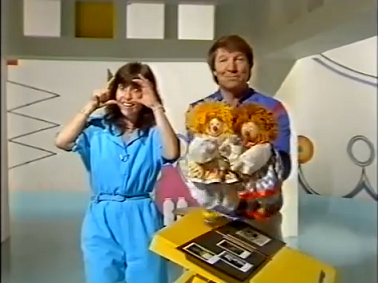
Hokey Cokey, right, it's a show about... well... there's two puppets, ok? Hokey and Cokey. They're operated by Don (Don Spencer) who likes to break into song every 30 seconds or so. He's an Australian too. There's also Chloe (Chloe Ashcroft) who is equally prone to breaking into song. She's English and rocks some amazing 80s jumpsuits. Carol (Carol Chell) also starred and, although we haven't seen any of her footage, we reckon she's up for a song or two. So, these songs, what are they about? Well, they have a strong footing in the realm of nonsense such as "Hooray for Eyes" song and the "Old Woman Tossed Up In a Basket" song. Some episodes have a strong consistent theme e.g. the 'Space' episode, but some episodes seem to be a nonstop jumble of songs, stories and animation e.g. the 'Cameras and Jungle' episode.
Another glorious chapter in the history of the See-Saw programming for children on the BBC, Hokey Cokey first aired in October 1983 and consisted of 26x 15 minute installments. The show was very much a cousin of Play School which starred both Spencer and Ashcroft. Executive producer for Hokey Cokey was Cynthia Felgate who also happened to be part of the crew behind Play Away (a sort of cousin-twice-removed of Hokey Cokey) which also featured Ashcroft.
The show was such a monster success at the time that it resulted in a record being released. Pretty swish, don't you think? Just imagine getting a few friends round, cracking open a bottle of spiced rum and dancing like a pirate to this! If only our record player hadn't been confiscated by the police after we played that Camberwick Green record at 78 rpm for 3 weeks...
The name Hokey Cokey kicked off a series of nostalgic happenings deep within our brain. The opening credits - some kids mucking about on an estate playground in London - further chimed with our subconscious, but we couldn't remember anything else. YouTube yielded two episodes, so we settled in for half an hour and got our viewing glasses (our eyes) on.
The sets are very cheap and point to a shoestring budget which was commonplace for children's television back in the 80s. We suspect the Playschool studio was quickly redressed to accommodate Hokey Cokey, but it doesn't really affect the show thanks to the rich and bewildering content taking place up front.
Don Spencer is absolutely fantastic in this and his antipodean confidence is a refreshing change from the era's standard avuncular male lead. His persona is an intriguing one as he looks completely comfortable with two frilly clown puppets attached to his arms, but you also wouldn't want to spill his pint of Castlemaine XXXX. A proven musician, Hokey Cokey is the perfect vehicle for Don and he takes it all in his stride. Chloe Ashcroft comes across as a slightly unhinged primary school teacher with her wide eyes and willingness to embrace the songs with a nice line in barmy interpretative dance skills.
As mentioned earlier, some episodes seem to be a mash up of ideas and material which point to a particulary strong vein of the avant-garde running through the show. Either that or they were pushed for time. It's an exciting approach though and ensures the show never drags - if you get bored by one section, you know something new will be along in two shakes of a tail. The space episode is more consistent, but no less entertaining with plenty of cutting from scene to scene.
And did we mention that there's even some basic chromakey action going on? Check it out in the 'Cameras and Jungle' episode. You'll be amazed that it had reached children's tv at this point. A whole 4 years before Knightmare went psychotic for it.
It's difficult to dislike Hokey Cokey as there's such a variety of ideas crammed into 15 minutes on such a tiny budget. The performers help make the show with their supreme confidence and appear very comfortable with material that could easily fluster someone less talented. We'd love to see more episodes and, in particular, some that feature Carol Chell to see how she compares. Hokey Cokey, then, is a show which deserves a little more recognition in the pantheon of classic children's TV.
Channel: BBC1
Transmission: 1983
Every little kid loves a song and particularly a song they can jive their tiny limbs to. If they don't, then there's something severely wrong with them and they're likely to end up packing jars of sauerkraut when they're older. And not just for a living, but for a hobby as well. We avoided these vile creatures at our playgroup and spent most of our time dancing the Hokey Cokey.
Hokey Cokey, right, it's a show about... well... there's two puppets, ok? Hokey and Cokey. They're operated by Don (Don Spencer) who likes to break into song every 30 seconds or so. He's an Australian too. There's also Chloe (Chloe Ashcroft) who is equally prone to breaking into song. She's English and rocks some amazing 80s jumpsuits. Carol (Carol Chell) also starred and, although we haven't seen any of her footage, we reckon she's up for a song or two. So, these songs, what are they about? Well, they have a strong footing in the realm of nonsense such as "Hooray for Eyes" song and the "Old Woman Tossed Up In a Basket" song. Some episodes have a strong consistent theme e.g. the 'Space' episode, but some episodes seem to be a nonstop jumble of songs, stories and animation e.g. the 'Cameras and Jungle' episode.
Another glorious chapter in the history of the See-Saw programming for children on the BBC, Hokey Cokey first aired in October 1983 and consisted of 26x 15 minute installments. The show was very much a cousin of Play School which starred both Spencer and Ashcroft. Executive producer for Hokey Cokey was Cynthia Felgate who also happened to be part of the crew behind Play Away (a sort of cousin-twice-removed of Hokey Cokey) which also featured Ashcroft.
The show was such a monster success at the time that it resulted in a record being released. Pretty swish, don't you think? Just imagine getting a few friends round, cracking open a bottle of spiced rum and dancing like a pirate to this! If only our record player hadn't been confiscated by the police after we played that Camberwick Green record at 78 rpm for 3 weeks...
The name Hokey Cokey kicked off a series of nostalgic happenings deep within our brain. The opening credits - some kids mucking about on an estate playground in London - further chimed with our subconscious, but we couldn't remember anything else. YouTube yielded two episodes, so we settled in for half an hour and got our viewing glasses (our eyes) on.
The sets are very cheap and point to a shoestring budget which was commonplace for children's television back in the 80s. We suspect the Playschool studio was quickly redressed to accommodate Hokey Cokey, but it doesn't really affect the show thanks to the rich and bewildering content taking place up front.
Don Spencer is absolutely fantastic in this and his antipodean confidence is a refreshing change from the era's standard avuncular male lead. His persona is an intriguing one as he looks completely comfortable with two frilly clown puppets attached to his arms, but you also wouldn't want to spill his pint of Castlemaine XXXX. A proven musician, Hokey Cokey is the perfect vehicle for Don and he takes it all in his stride. Chloe Ashcroft comes across as a slightly unhinged primary school teacher with her wide eyes and willingness to embrace the songs with a nice line in barmy interpretative dance skills.
As mentioned earlier, some episodes seem to be a mash up of ideas and material which point to a particulary strong vein of the avant-garde running through the show. Either that or they were pushed for time. It's an exciting approach though and ensures the show never drags - if you get bored by one section, you know something new will be along in two shakes of a tail. The space episode is more consistent, but no less entertaining with plenty of cutting from scene to scene.
And did we mention that there's even some basic chromakey action going on? Check it out in the 'Cameras and Jungle' episode. You'll be amazed that it had reached children's tv at this point. A whole 4 years before Knightmare went psychotic for it.
It's difficult to dislike Hokey Cokey as there's such a variety of ideas crammed into 15 minutes on such a tiny budget. The performers help make the show with their supreme confidence and appear very comfortable with material that could easily fluster someone less talented. We'd love to see more episodes and, in particular, some that feature Carol Chell to see how she compares. Hokey Cokey, then, is a show which deserves a little more recognition in the pantheon of classic children's TV.
Saturday, 26 July 2014
No - That's Me Over Here!
Genre: Sitcom
Channel: ITV
Transmission: 1967 - 1970
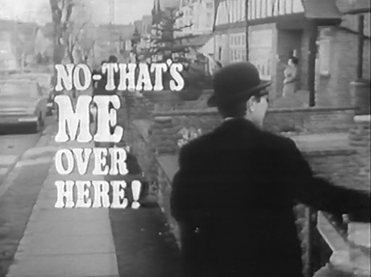
Ah! The office! What a wonderful environment to indulge in a spot of reckless backstabbing! How else are you going to climb the ladder, get the company car and then take that busty, low top wearing secretary on a "business trip" to Monte Carlo? You'd never catch this sort of behaviour going on in the Curious British Telly office, of course, but that's only because we can't afford a secretary. A much better example of this competitive and ambitious rivalry can be analysed in the guise of No - That's Me Over Here!
Office Life
City Life & Fire Insurance Co. Ltd is home to suburban commuter Ronnie Corbett (Ronnie Corbett!) who is an aspirational chap keen on impressing the boss, Mr Robinson (Ivor Dean). Cyril (Henry McGee) works in Ronnie's department, shares the same commute to work every morning and finds himself living as Ronnie's neighbour. Frankly, he's sick of Ronnie, so does his best to come up with dastardly schemes to hoist Ronnie with his own petard and take all the glory for himself.
A Magnificent Team
The year is 1967 and Britain's funny bone is being mercilessly tickled by a burgeoning comedy boom. David Frost, suitably impressed with the success of The Frost Report, now has his sights set on the world of sitcom.
Convening under the careful watch of his executive producer's eye are Graham Chapman, Barry Cryer and Eric Idle - all fresh from working on The Frost Report. Together they've crafted an idea involving a man with high aspirations working in an insurance office. David Frost brings in another alumni of The Frost Report in the guise of Ronnie Corbett, as the show's leading man, and Associated-Rediffusion have no option but to bite their hands off.
No - That's Me Over Here! notched up three series between 1967 - 1970 on ITV. The first two series were recorded in black and white and produced by ITV contractor Associated-Rediffusion. Legend has it that the first two series are consigned to the wilderness of missing episodes. However, Curious British Telly got hold of one of these episodes fairly easily, so the true archival status of the first two series is a little murky.
For the final series, which went out in colour, the series was produced by LWT, a move precipitated by David Frost setting up home there. This series finally received a DVD release in 2015.
Oh and Eric Idle buggered off after the first series. God knows whatever became of him.
Ah, There You Are!
Curious British Telly grew up watching The Two Ronnies and Sorry, so we've always had a soft spot for Ronnie Corbett. Once we discovered there was a barely remembered sitcom featuring him with a couple of Pythons involved, we had no choice but to take a look. There were a few little snippets here and there on the net, the occasional screenshot, but not much else.
A public appeal was launched for help in tracking down some episodes and, in next to no time, someone had kindly contacted us to offer two episodes. And, good heavens, one of the episodes was in black and white! And from the 60s! A double first for Curious British Telly!
Ronnie Corbett, not surprisingly, won very few, if any, Best Actor awards, but he was an immensably likeable chap whose smile was beloved by grannies, small children and those irritating tossers in pubs who eulogise about the Four Candles sketch. In No - That's Me Over Here! you can tell he's giving it all in his first leading role and he conjures up some fine moments of physical comedy.
Our favourite performance in the series, though, is from Henry McGee who personifies the Great British Cad with moustache twiddling ease. Sadly, the rest of the actors lack any real vigour and are nothing more than stereotypical sitcom performances, but this would hardly be the first sitcom from this era to suffer from poorly written characters.
The plots, well, they're an incredible distillation of everything that was funny in the 60s and early 70s. Gents wearing bowler hats, keeping up with the Joneses in Suburbia and a hint of xenophobia.
Take the black and white episode we watched, the plot essentially boils down to this: Ronnie has invited his boss round to dinner in order to get a promotion that Cyril also wants. Ronnie's boss, of course, fought in World War 2. Ronnie's wife, therefore, just happens to have invited Jurgen round for dinner the same night. Jurgen is German. Ronnie pretends Jurgen is Swiss. Cyril pops round to meddle. It could only get more cliché if a vicar walked in, his trousers fell down and his groin had been replaced with Marty Feldman's face. Feldman was actually involved, but purely in a producers role.
The colour episode we watched wasn't quite as predictable and there were a couple of great scenes which featured Ronnie going to extreme lengths to retrieve a letter of resignation he had been tricked into handing in. On the whole, though, the laughs were sparse and the action rather lacklustre. Matters aren't helped by poorly developed characters who have only a few interesting facets stapled onto willing actors. A bit more time spent on the characters' hopes, wants and needs rather than just skimming the surface could have made for something more rounded that viewers could invest in.
Final Thoughts
No - That's Me Over Here! was a fairly disappointing watch and, even though it managed three series, we're not surprised it's barely remembered by the British public. The content simply isn't rich enough and we couldn't engage with the show in the way that, all these years later, we still do with Til Death Us Do Part, Steptoe and Son and Dad's Army.
People look back at 60s and 70s comedy with rose tinted glasses, but for every classic sitcom there were plenty of middling, uninspiring sitcoms such as No - That's Me Over Here! We'd probably watch a few more episodes out of sheer curiousity, but we won't be travelling the globe in search of them.
Channel: ITV
Transmission: 1967 - 1970
Ah! The office! What a wonderful environment to indulge in a spot of reckless backstabbing! How else are you going to climb the ladder, get the company car and then take that busty, low top wearing secretary on a "business trip" to Monte Carlo? You'd never catch this sort of behaviour going on in the Curious British Telly office, of course, but that's only because we can't afford a secretary. A much better example of this competitive and ambitious rivalry can be analysed in the guise of No - That's Me Over Here!
Office Life
City Life & Fire Insurance Co. Ltd is home to suburban commuter Ronnie Corbett (Ronnie Corbett!) who is an aspirational chap keen on impressing the boss, Mr Robinson (Ivor Dean). Cyril (Henry McGee) works in Ronnie's department, shares the same commute to work every morning and finds himself living as Ronnie's neighbour. Frankly, he's sick of Ronnie, so does his best to come up with dastardly schemes to hoist Ronnie with his own petard and take all the glory for himself.
A Magnificent Team
The year is 1967 and Britain's funny bone is being mercilessly tickled by a burgeoning comedy boom. David Frost, suitably impressed with the success of The Frost Report, now has his sights set on the world of sitcom.
Convening under the careful watch of his executive producer's eye are Graham Chapman, Barry Cryer and Eric Idle - all fresh from working on The Frost Report. Together they've crafted an idea involving a man with high aspirations working in an insurance office. David Frost brings in another alumni of The Frost Report in the guise of Ronnie Corbett, as the show's leading man, and Associated-Rediffusion have no option but to bite their hands off.
No - That's Me Over Here! notched up three series between 1967 - 1970 on ITV. The first two series were recorded in black and white and produced by ITV contractor Associated-Rediffusion. Legend has it that the first two series are consigned to the wilderness of missing episodes. However, Curious British Telly got hold of one of these episodes fairly easily, so the true archival status of the first two series is a little murky.
For the final series, which went out in colour, the series was produced by LWT, a move precipitated by David Frost setting up home there. This series finally received a DVD release in 2015.
Oh and Eric Idle buggered off after the first series. God knows whatever became of him.
Ah, There You Are!
Curious British Telly grew up watching The Two Ronnies and Sorry, so we've always had a soft spot for Ronnie Corbett. Once we discovered there was a barely remembered sitcom featuring him with a couple of Pythons involved, we had no choice but to take a look. There were a few little snippets here and there on the net, the occasional screenshot, but not much else.
A public appeal was launched for help in tracking down some episodes and, in next to no time, someone had kindly contacted us to offer two episodes. And, good heavens, one of the episodes was in black and white! And from the 60s! A double first for Curious British Telly!
Ronnie Corbett, not surprisingly, won very few, if any, Best Actor awards, but he was an immensably likeable chap whose smile was beloved by grannies, small children and those irritating tossers in pubs who eulogise about the Four Candles sketch. In No - That's Me Over Here! you can tell he's giving it all in his first leading role and he conjures up some fine moments of physical comedy.
Our favourite performance in the series, though, is from Henry McGee who personifies the Great British Cad with moustache twiddling ease. Sadly, the rest of the actors lack any real vigour and are nothing more than stereotypical sitcom performances, but this would hardly be the first sitcom from this era to suffer from poorly written characters.
The plots, well, they're an incredible distillation of everything that was funny in the 60s and early 70s. Gents wearing bowler hats, keeping up with the Joneses in Suburbia and a hint of xenophobia.
Take the black and white episode we watched, the plot essentially boils down to this: Ronnie has invited his boss round to dinner in order to get a promotion that Cyril also wants. Ronnie's boss, of course, fought in World War 2. Ronnie's wife, therefore, just happens to have invited Jurgen round for dinner the same night. Jurgen is German. Ronnie pretends Jurgen is Swiss. Cyril pops round to meddle. It could only get more cliché if a vicar walked in, his trousers fell down and his groin had been replaced with Marty Feldman's face. Feldman was actually involved, but purely in a producers role.
The colour episode we watched wasn't quite as predictable and there were a couple of great scenes which featured Ronnie going to extreme lengths to retrieve a letter of resignation he had been tricked into handing in. On the whole, though, the laughs were sparse and the action rather lacklustre. Matters aren't helped by poorly developed characters who have only a few interesting facets stapled onto willing actors. A bit more time spent on the characters' hopes, wants and needs rather than just skimming the surface could have made for something more rounded that viewers could invest in.
Final Thoughts
No - That's Me Over Here! was a fairly disappointing watch and, even though it managed three series, we're not surprised it's barely remembered by the British public. The content simply isn't rich enough and we couldn't engage with the show in the way that, all these years later, we still do with Til Death Us Do Part, Steptoe and Son and Dad's Army.
People look back at 60s and 70s comedy with rose tinted glasses, but for every classic sitcom there were plenty of middling, uninspiring sitcoms such as No - That's Me Over Here! We'd probably watch a few more episodes out of sheer curiousity, but we won't be travelling the globe in search of them.
Thursday, 19 June 2014
Agent Z and the Penguin from Mars
Genre: Childrens
Channel: BBC
Transmission: 03/01/1996 - 07/02/1996
Every schoolkid - at least every schoolboy, God knows what girls get up to at that age - loves to play a prank and laugh at their victim's horrified face. On the face of it, it's bullying, but if you can justify the jest you avoid the smear of being a mean rascal. It's where every comedian starts off in life. Probably. We can certainly imagine a fledgling Johnny Vegas tar and feathering his Aunt for example. Anyway, yes, PRANKS! The BBC decided this would be the perfect way to engage with the mid 90s youth, but didn't want to tit about with buckets of waters being balanced precariously atop doors. No, they wanted to go much bigger, so commissioned an adaptation of Agent Z and the Penguin from Mars.
The Crane Grove Gang is a collective of youngsters comprised of Ben Simpson (Duncan Barton), Barney (Andrew McKay) and Jenks (Reggie Yates) who just happen to live on Crane Grove. This isn't the only alias they operate under though, the pranking wing of their enterprise is known as Agent Z. The gang are happily pranking the public with ventures such as dressing up as a gorilla on the loose when Ben finds himself with a new set of neighbours - The Sidebottoms, headed up by lottery winner Dennis (Rod Culbertson) with his wife Patricia (Pamela Power) and kids Tod (Andrew Wheeler) and Samantha (Nicola Mycroft).
Ben attempts to take Tod under his wing, but soon discovers that Tod is a sneaky, little rat who manages to portray himself as the perfect son to his parents. After Tod is caught shoplifting a Dolly Parton CD, Dennis pins the blame on Ben and threatens to make his life very difficult. Agent Z is called into action with their biggest prank yet, one which aims to exploit Dennis' love of astronomy and a penguin 'borrowed' from the local shopping centre.
Agent Z and the Penguin from Mars was a 1996 adaptation of Mark Haddon's novel of the same name. It aired on BBC1 on Wednesdays under the CBBC umbrella and was script edited by Marilyn Fox, a talented individual who has popped up on our blog countless times. The series was never repeated and no more of Haddon's Agent Z novels were adapted for TV. YouTube currently houses the entire serial for those looking to relive the adventure.
Curious British Telly eagerly tuned in to Agent Z each week back in those short winter days of 1996 and really connected with it. We were roughly the same age as the protagonists and the world of elaborate pranks really caught our imagination - a prank for us usually revolved around a fake dog turd being chucked at one of our mates. One reason that Agent Z always stuck in our mind was due to us being inspired to start writing a book about 3 pranksters - all we remember was coming up with some mundane plots e.g. one plot was that one of them had gone on holiday to the Norfolk coast, so the other two had to do pranks on their own. We didn't get very far with writing it. Maybe a page. It was a strange age where we were on the cusp of wanting to investigate more adult pursuits, but still intrigued by schoolboy japes. Would the series hold up to our mature eyes of 2014?!
First off, Reggie Yates?! Reggie Yates was a thing back then? We had no idea he had starred in this. He doesn't make too much of an impression here, he's mostly used for comic relief. We remember connecting with Duncan Barton's Ben character at the time, probably because he personified the average 12/13 year old with hints of anxiety and vulnerability. However, this time round, we found him a little sappy at times. Barney's character was much more appealing this time round with his cocksure and cheeky attitude. We'd want to be Barney now. You just know he's going to grow up and get the ladies.
Rod Culbertson gives one of the best performances in the series as Dennis as he captures the arrogant father with perfect menace. Andrew Wheeler as Tod isn't a great actor, but his weasel-like ways left us wanting to punch him up the bracket, so he achieved his characters aim. Final mention goes to Ian Sharrock as Ben's father, Trevor, who we recognised as Jed Maxwell from I'm Alan Partridge. He plays a likeable, nice guy Dad and we're surprised that his acting career ground to a halt just a few years later.
The story ticks along nicely and the plot builds nicely as - despite the big set piece half way through the series - the situation takes more and more absurd turns. The production team are helped by the magic touch of Marilyn Fox and also the talented storytelling of Mark Haddon which has seen him go on to win numerous awards including the Whitbread Award. We were a little annoyed that Tod disappears for nearly two episodes as he's such a deceptive little worm that he makes a great antagonist. There's also a half started plot revolving around a potential romance between Ben and Samantha Sidebottom, but this seems to evaporate fairly early on when it could have helped increase the tension between Ben and Dennis.
The series has a satisfying end and we enjoyed rewatching it nearly 20 years on from transmission. It's got a snappy feel to proceedings although a lot of the jokes fall flat. Ultimately, though, it takes us back to the days of being part of a gang messing about, years before the allure of women and alcohol took over our interests. It is, of course, also incredibly 90s with it's god-awful waistcoats, Wonderwall playing in HMV and Ben's Zig and Zag bedspread. It's a pity that no more series' followed as it's a likeable show if not a stone cold classic.
Channel: BBC
Transmission: 03/01/1996 - 07/02/1996
Every schoolkid - at least every schoolboy, God knows what girls get up to at that age - loves to play a prank and laugh at their victim's horrified face. On the face of it, it's bullying, but if you can justify the jest you avoid the smear of being a mean rascal. It's where every comedian starts off in life. Probably. We can certainly imagine a fledgling Johnny Vegas tar and feathering his Aunt for example. Anyway, yes, PRANKS! The BBC decided this would be the perfect way to engage with the mid 90s youth, but didn't want to tit about with buckets of waters being balanced precariously atop doors. No, they wanted to go much bigger, so commissioned an adaptation of Agent Z and the Penguin from Mars.
The Crane Grove Gang is a collective of youngsters comprised of Ben Simpson (Duncan Barton), Barney (Andrew McKay) and Jenks (Reggie Yates) who just happen to live on Crane Grove. This isn't the only alias they operate under though, the pranking wing of their enterprise is known as Agent Z. The gang are happily pranking the public with ventures such as dressing up as a gorilla on the loose when Ben finds himself with a new set of neighbours - The Sidebottoms, headed up by lottery winner Dennis (Rod Culbertson) with his wife Patricia (Pamela Power) and kids Tod (Andrew Wheeler) and Samantha (Nicola Mycroft).
Ben attempts to take Tod under his wing, but soon discovers that Tod is a sneaky, little rat who manages to portray himself as the perfect son to his parents. After Tod is caught shoplifting a Dolly Parton CD, Dennis pins the blame on Ben and threatens to make his life very difficult. Agent Z is called into action with their biggest prank yet, one which aims to exploit Dennis' love of astronomy and a penguin 'borrowed' from the local shopping centre.
Agent Z and the Penguin from Mars was a 1996 adaptation of Mark Haddon's novel of the same name. It aired on BBC1 on Wednesdays under the CBBC umbrella and was script edited by Marilyn Fox, a talented individual who has popped up on our blog countless times. The series was never repeated and no more of Haddon's Agent Z novels were adapted for TV. YouTube currently houses the entire serial for those looking to relive the adventure.
Curious British Telly eagerly tuned in to Agent Z each week back in those short winter days of 1996 and really connected with it. We were roughly the same age as the protagonists and the world of elaborate pranks really caught our imagination - a prank for us usually revolved around a fake dog turd being chucked at one of our mates. One reason that Agent Z always stuck in our mind was due to us being inspired to start writing a book about 3 pranksters - all we remember was coming up with some mundane plots e.g. one plot was that one of them had gone on holiday to the Norfolk coast, so the other two had to do pranks on their own. We didn't get very far with writing it. Maybe a page. It was a strange age where we were on the cusp of wanting to investigate more adult pursuits, but still intrigued by schoolboy japes. Would the series hold up to our mature eyes of 2014?!
First off, Reggie Yates?! Reggie Yates was a thing back then? We had no idea he had starred in this. He doesn't make too much of an impression here, he's mostly used for comic relief. We remember connecting with Duncan Barton's Ben character at the time, probably because he personified the average 12/13 year old with hints of anxiety and vulnerability. However, this time round, we found him a little sappy at times. Barney's character was much more appealing this time round with his cocksure and cheeky attitude. We'd want to be Barney now. You just know he's going to grow up and get the ladies.
Rod Culbertson gives one of the best performances in the series as Dennis as he captures the arrogant father with perfect menace. Andrew Wheeler as Tod isn't a great actor, but his weasel-like ways left us wanting to punch him up the bracket, so he achieved his characters aim. Final mention goes to Ian Sharrock as Ben's father, Trevor, who we recognised as Jed Maxwell from I'm Alan Partridge. He plays a likeable, nice guy Dad and we're surprised that his acting career ground to a halt just a few years later.
The story ticks along nicely and the plot builds nicely as - despite the big set piece half way through the series - the situation takes more and more absurd turns. The production team are helped by the magic touch of Marilyn Fox and also the talented storytelling of Mark Haddon which has seen him go on to win numerous awards including the Whitbread Award. We were a little annoyed that Tod disappears for nearly two episodes as he's such a deceptive little worm that he makes a great antagonist. There's also a half started plot revolving around a potential romance between Ben and Samantha Sidebottom, but this seems to evaporate fairly early on when it could have helped increase the tension between Ben and Dennis.
The series has a satisfying end and we enjoyed rewatching it nearly 20 years on from transmission. It's got a snappy feel to proceedings although a lot of the jokes fall flat. Ultimately, though, it takes us back to the days of being part of a gang messing about, years before the allure of women and alcohol took over our interests. It is, of course, also incredibly 90s with it's god-awful waistcoats, Wonderwall playing in HMV and Ben's Zig and Zag bedspread. It's a pity that no more series' followed as it's a likeable show if not a stone cold classic.
Saturday, 19 April 2014
The Blunders
Genre: Childrens
Channel: ITV
Transmission: 1986 - 87
Life is often little more than a series of blunders. They're rather inconvenient, but from these blunders we can learn and modify our future behaviour to make life less troublesome. TV executives are certainly not immune to making gaffes - some even appear to have made a career from it - but what would they learn from The Blunders?
The Blunder family (Ma Blunder, Pa Blunder, Bobby Blunder, Baby Blunder, Zebra the cat, Trouble the dog and Patch the Bird) all live in bungled harmony in the curiously named town of Villa Shambles. They blunder here, they blunder there and more often than not they bugger things up. The other inhabitants of Villa Shambles tend to shudder at the sight of the Blunder family and wildly scratch at their sides to remove the metaphorical thorn that they are.
The Blunders was an animated offering by the legendary talents of children's TV known as FilmFair in conjunction with Central Television. 30 five-minute episodes aired on ITV between 1986 - 87 and all the voices were provided by that British institution known as Frankie Howerd. Wonderfully named duo Colin Voisey and Haydn Moran created the Blunder family and Ian Sachs was on hand to write the episodes. The animation was completed by Geoff Loynes whilst the artists on hand were Alison Johnston, Theresa Whatley and Deborah Johnson. The theme tune and lyrics was the result of a collaboration between Chris Stuart and Robin Lyons. Both Castle Vision and Thorn EMI Video released VHS releases.
We were trawling through a long list of children's TV shows when we happened upon The Blunders. Despite it airing when we were a cognisant child, the name rang no bells with us. A few tiny mentions of it popped up online, but no more than that and no one we spoke to had heard of it either. We discovered that it featured Frankie Howerd and this intrigued us as he had the perfect voice for children's TV. YouTube yielded no footage, but luckily, we found a shady site selling 10 episodes on DVD (presumably cribbed from one of the VHS releases), so soon had the show in our grasps.
Frankly, The Blunders is nothing short of a disaster. It start wells with the zingy, brass filled theme tune and Frankie Howerd's delivery of the lyrics is pitch perfect, but then it's all downhill.
The animation is well below par from FilmFair. Can you remember those adverts in the backs of magazines which promised to turn you into a cartoonist? You'd send off a cheque (or postal order) and receive a handmade booklet taking you through the basics of drawing cartoons. Friends and family would marvel at your 'rushing man' and 'wiseass bunny' whilst proclaiming that "Walt Disney better watch out as Colin Fletcher is now in town!". In reality, they were generic, characterless sketches with no soul and The Blunders is no better.
Perhaps we would forgive the amateur level of animation if the stories and gags were of such a high calibre that grown playwrights would openly weep, but, nah, plenty of dry eyes in the house. For a comedy show to work you need a little blundering, but not non-stop blundering which irritates the viewer. There's no skilled imagination trying to craft warm and witty tales here. Instead, there's just a load of titting about from characters we want to slap round the face.
Why on Earth Central Television commissioned thirty episodes of this diabolical mess is utterly beyond us. We try to find positives in most shows we look back at, but all this show did was annoy us that we'd wasted several quid on it. Still, reviewing the hidden depths of British TV was never going to be pretty. The one good thing with The Blunders is that a TV executive looked at the blunder of commisioning this show and learnt what a catastrophe it was, so a second series never appeared. Our opinion is: AVOID!
.
Channel: ITV
Transmission: 1986 - 87
Life is often little more than a series of blunders. They're rather inconvenient, but from these blunders we can learn and modify our future behaviour to make life less troublesome. TV executives are certainly not immune to making gaffes - some even appear to have made a career from it - but what would they learn from The Blunders?
The Blunder family (Ma Blunder, Pa Blunder, Bobby Blunder, Baby Blunder, Zebra the cat, Trouble the dog and Patch the Bird) all live in bungled harmony in the curiously named town of Villa Shambles. They blunder here, they blunder there and more often than not they bugger things up. The other inhabitants of Villa Shambles tend to shudder at the sight of the Blunder family and wildly scratch at their sides to remove the metaphorical thorn that they are.
The Blunders was an animated offering by the legendary talents of children's TV known as FilmFair in conjunction with Central Television. 30 five-minute episodes aired on ITV between 1986 - 87 and all the voices were provided by that British institution known as Frankie Howerd. Wonderfully named duo Colin Voisey and Haydn Moran created the Blunder family and Ian Sachs was on hand to write the episodes. The animation was completed by Geoff Loynes whilst the artists on hand were Alison Johnston, Theresa Whatley and Deborah Johnson. The theme tune and lyrics was the result of a collaboration between Chris Stuart and Robin Lyons. Both Castle Vision and Thorn EMI Video released VHS releases.
We were trawling through a long list of children's TV shows when we happened upon The Blunders. Despite it airing when we were a cognisant child, the name rang no bells with us. A few tiny mentions of it popped up online, but no more than that and no one we spoke to had heard of it either. We discovered that it featured Frankie Howerd and this intrigued us as he had the perfect voice for children's TV. YouTube yielded no footage, but luckily, we found a shady site selling 10 episodes on DVD (presumably cribbed from one of the VHS releases), so soon had the show in our grasps.
Frankly, The Blunders is nothing short of a disaster. It start wells with the zingy, brass filled theme tune and Frankie Howerd's delivery of the lyrics is pitch perfect, but then it's all downhill.
The animation is well below par from FilmFair. Can you remember those adverts in the backs of magazines which promised to turn you into a cartoonist? You'd send off a cheque (or postal order) and receive a handmade booklet taking you through the basics of drawing cartoons. Friends and family would marvel at your 'rushing man' and 'wiseass bunny' whilst proclaiming that "Walt Disney better watch out as Colin Fletcher is now in town!". In reality, they were generic, characterless sketches with no soul and The Blunders is no better.
Perhaps we would forgive the amateur level of animation if the stories and gags were of such a high calibre that grown playwrights would openly weep, but, nah, plenty of dry eyes in the house. For a comedy show to work you need a little blundering, but not non-stop blundering which irritates the viewer. There's no skilled imagination trying to craft warm and witty tales here. Instead, there's just a load of titting about from characters we want to slap round the face.
Why on Earth Central Television commissioned thirty episodes of this diabolical mess is utterly beyond us. We try to find positives in most shows we look back at, but all this show did was annoy us that we'd wasted several quid on it. Still, reviewing the hidden depths of British TV was never going to be pretty. The one good thing with The Blunders is that a TV executive looked at the blunder of commisioning this show and learnt what a catastrophe it was, so a second series never appeared. Our opinion is: AVOID!
.
Saturday, 22 March 2014
Galloping Galaxies
Genre: Childrens
Channel: BBC1
Transmission: 01/10/1985 - 29/10/1985 & 21/11/1986 - 18/12/1986
"Great galloping galaxies!" is a piece of dialogue in the mathematical sociology novel 'Foundation' by Isaac Asimov. It's a gripping story about... uh... long division ASBOs? Maybe? Frankly, we're not too bothered as we aren't a damn retro book blog, we're a God damn retro telly blog! Much more gripping to us, and you, is the sci-fi comedy romp entitled Galloping Galaxies.
It's the year 2487 and the crew of the merchant spaceship Voyager are hurtling through space led by Captain Pettifer (Robert Swales). Making up his crew are First Office Morton (Paul Wilce) and Second Officer Elliott (James Mansfield). They're also aided and abetted by the ship's bog eyed computer SID aka Super Intelligent Deducer (Kenneth Williams).
Life in outer space is never easy and the crew experience troubles such as mistakenly beaming aboard Miss Appleby (Priscilla Morgan) from the 20th century. Trying to put a spanner in the crew's works are the robot pirates Paddy O'Twenty/Robot 20 (Matthew Sim) and Sean O'Seven/Robot 7 (Michael Deeks) who are put to task by their pirate chief Mick Murphy (Sean Caffrey/Niall Buggy).
Galloping Galaxies first warped into view with 5 episodes in 1985 and a second series followed in 1986 with another 5 tales of space adventures. These futuristic visions of space dystopia were dreamt up by Bob Block who was otherwise known as "that geezer behind Pardon My Genie and Rentaghost". Jeremy Swan - who had previously directed Rentaghost - was entrusted with recreating Block's vision for the BBC. A novelisation of the first series was released by Target in 1987 and the second series was due to follow in book form, but this never materialised. No commercial release of Galloping Galaxies has ever appeared. The first series was repeated between August - September 1987 and a repeat of the second series aired in the same slot a year later.
Galloping Galaxies was a year or so too early for us. We were watching television in 1985, but were probably in bed when the show aired. Or refusing to eat greens. Until we have time travel technology we can't pinpoint our exact TV habits. Anyway, we first heard about the series during a Twitter love-in about forgotten shows. It appealed to us primarily as it's sci-fi and that it was one of Kenneth Williams' final roles.Anyway, episode two of series one is up on YouTube (just about watchable), but we didn't want to charge in halfcocked. To help get a handle on the show, we took a trip down to the BFI Archive to watch episode one first.
You know what? We really loved Galloping Galaxies. It's like some freewheeling cocktail expert has grabbed his cobbler shaker, chucked in a couple of shots of Douglas Adams, squeezed in a dash of Carry On and garnished with some terrible special effects. It's the vodka martini to our James Bond of retro telly investigation.
The gags are sharply written and neither condescending or childish - this is good as it means we don't feel ridiculous watching a kids show. Kenneth Williams' vocal strengths are used to their full potential and there's even room for some double entendres e.g. Morton starts rooting around in SID's circuitry prompting SID to cry "Oooh! Here, take your hands off my floppy discs!". A very British vein of humour runs throughout from Miss Appleby's middle class preoccupations to the foolish Irish robots. Bob Block - who is sadly no longer with us - gets a 21 cannon salute from us for his hilarious scripts.
Performances didn't disappoint and we were rather bemused that barely any of the cast went on to carve out a career. The performances of Robot 7 and Robot 20 are zingy affairs and they're surely the prototypes for Jedward - sadly, lessons were not learnt and their spiritual heirs continue to pop up on our screeens. Robert Swales puts in a commanding role as the suave Pettifer and the rest of his crew work well around him. It's a great cast which really lift it above other wooden fare from the same era.
The internal sets for are actually pretty good. They're simple, but colourful and haven't dated terribly. The special effects, on the other hand, appear to be stuck in the 1970s - namely Revenge of the Cybermen. What else, though, can you expect from a cash strapped children's department in the 80s? It's not going to be Blade Runner, but surely there must have been enough bits and pieces left over from Doctor Who to make the space scenes a bit more visually appealing.
We've only seen 2 episodes, so there's another 8 for us to watch and we already feel like we're going cold turkey. The only guaranteed fix for our addiction is a marathon viewing session at the BFI Archive. It's a rather expensive proposal though, so we fear we may end up resorting to petty crime to fund our habit. Of course, if anyone out there has access to any other episodes, then get in touch as we do have some moneys! In the mean time, we'll just have to dine on memories of a wonderfully pitched show packed full of laughs and decent performances.
INTERVIEW
You may be asking yourself what the original working title of Galloping Galaxies was, so why not read our interview with director, Jeremy Swan, to find out a bit more about the show!
PRESS CUTTINGS
Radio Times 28th September - 4th October 1985 pg.86
Glasgow Herald - 19th December 1986 pg.32
Channel: BBC1
Transmission: 01/10/1985 - 29/10/1985 & 21/11/1986 - 18/12/1986
"Great galloping galaxies!" is a piece of dialogue in the mathematical sociology novel 'Foundation' by Isaac Asimov. It's a gripping story about... uh... long division ASBOs? Maybe? Frankly, we're not too bothered as we aren't a damn retro book blog, we're a God damn retro telly blog! Much more gripping to us, and you, is the sci-fi comedy romp entitled Galloping Galaxies.
It's the year 2487 and the crew of the merchant spaceship Voyager are hurtling through space led by Captain Pettifer (Robert Swales). Making up his crew are First Office Morton (Paul Wilce) and Second Officer Elliott (James Mansfield). They're also aided and abetted by the ship's bog eyed computer SID aka Super Intelligent Deducer (Kenneth Williams).
Life in outer space is never easy and the crew experience troubles such as mistakenly beaming aboard Miss Appleby (Priscilla Morgan) from the 20th century. Trying to put a spanner in the crew's works are the robot pirates Paddy O'Twenty/Robot 20 (Matthew Sim) and Sean O'Seven/Robot 7 (Michael Deeks) who are put to task by their pirate chief Mick Murphy (Sean Caffrey/Niall Buggy).
Galloping Galaxies first warped into view with 5 episodes in 1985 and a second series followed in 1986 with another 5 tales of space adventures. These futuristic visions of space dystopia were dreamt up by Bob Block who was otherwise known as "that geezer behind Pardon My Genie and Rentaghost". Jeremy Swan - who had previously directed Rentaghost - was entrusted with recreating Block's vision for the BBC. A novelisation of the first series was released by Target in 1987 and the second series was due to follow in book form, but this never materialised. No commercial release of Galloping Galaxies has ever appeared. The first series was repeated between August - September 1987 and a repeat of the second series aired in the same slot a year later.
Galloping Galaxies was a year or so too early for us. We were watching television in 1985, but were probably in bed when the show aired. Or refusing to eat greens. Until we have time travel technology we can't pinpoint our exact TV habits. Anyway, we first heard about the series during a Twitter love-in about forgotten shows. It appealed to us primarily as it's sci-fi and that it was one of Kenneth Williams' final roles.Anyway, episode two of series one is up on YouTube (just about watchable), but we didn't want to charge in halfcocked. To help get a handle on the show, we took a trip down to the BFI Archive to watch episode one first.
You know what? We really loved Galloping Galaxies. It's like some freewheeling cocktail expert has grabbed his cobbler shaker, chucked in a couple of shots of Douglas Adams, squeezed in a dash of Carry On and garnished with some terrible special effects. It's the vodka martini to our James Bond of retro telly investigation.
The gags are sharply written and neither condescending or childish - this is good as it means we don't feel ridiculous watching a kids show. Kenneth Williams' vocal strengths are used to their full potential and there's even room for some double entendres e.g. Morton starts rooting around in SID's circuitry prompting SID to cry "Oooh! Here, take your hands off my floppy discs!". A very British vein of humour runs throughout from Miss Appleby's middle class preoccupations to the foolish Irish robots. Bob Block - who is sadly no longer with us - gets a 21 cannon salute from us for his hilarious scripts.
Performances didn't disappoint and we were rather bemused that barely any of the cast went on to carve out a career. The performances of Robot 7 and Robot 20 are zingy affairs and they're surely the prototypes for Jedward - sadly, lessons were not learnt and their spiritual heirs continue to pop up on our screeens. Robert Swales puts in a commanding role as the suave Pettifer and the rest of his crew work well around him. It's a great cast which really lift it above other wooden fare from the same era.
The internal sets for are actually pretty good. They're simple, but colourful and haven't dated terribly. The special effects, on the other hand, appear to be stuck in the 1970s - namely Revenge of the Cybermen. What else, though, can you expect from a cash strapped children's department in the 80s? It's not going to be Blade Runner, but surely there must have been enough bits and pieces left over from Doctor Who to make the space scenes a bit more visually appealing.
We've only seen 2 episodes, so there's another 8 for us to watch and we already feel like we're going cold turkey. The only guaranteed fix for our addiction is a marathon viewing session at the BFI Archive. It's a rather expensive proposal though, so we fear we may end up resorting to petty crime to fund our habit. Of course, if anyone out there has access to any other episodes, then get in touch as we do have some moneys! In the mean time, we'll just have to dine on memories of a wonderfully pitched show packed full of laughs and decent performances.
INTERVIEW
You may be asking yourself what the original working title of Galloping Galaxies was, so why not read our interview with director, Jeremy Swan, to find out a bit more about the show!
CBT: Hello, Jeremy! Many thanks for sitting down for a quick
chat with us! What exactly are you up to these days?
Jeremy: These days I work mainly as a painter (pictures, not walls),
I write plays, one has been performed –
and within living memory I’ve directed a couple of episodes of SOOTY for ITV.
You’ve worked on iconic shows such as Sooty, Rentaghost
and Jackanory, but how did you get started in in the world of children’s
television?
I started in Children’s Television as the AFM (Assistant
Floor Manager) on JACKANORY in 1967 and eventually became a director of the
programme.
We mentioned Rentaghost just now, which was also a Bob
Block show, so is this what led to you getting involved in Galloping Galaxies?
Bob also wrote GRANDAD, starring Clive Dunn, which I produced and directed; and the BBC
greatly appreciated his unique talent – so any new writings from him were
encouraged. As with RENTAGHOST and GRANDAD, his latest scripts came into my section
of the department’s output – I had inherited this position from Paul Ciani – a
producer who had gone on a BBC attachment to Singapore.
What can you remember about the initial stages in getting
Galloping Galaxies off the ground?
Originally it was called WORLD’S APART. I thought that title
was too documentary and a bit suggestive of some sinister late-night probe on
BBC2 ……. So I came up with GALLOPING GALAXIES! The initial scripts lacked a
central core and, after a visit to 2001, came up with a computer character.
Thank you, Stanley Kubrick! I’d done a lot of JACKANORYS with Kenneth Williams
so SID was a great excuse to work together again. And Miss Appleby was played by Priscilla
Morgan – Mrs Clive Dunn
We were really impressed with the quality of the scripts
and performances, but did everything run just as smoothly behind the camera?
Thank you – yes, it did.
The BBC were notoriously disapproving of children’s
sci-fi in the mid-80s with Doctor Who going on hiatus and The Tripods third
series being cancelled. Did Galloping Galaxies ever encounter any issues with
the powers that be?
No.
Kenneth Williams has been described as an incredibly
talented individual, but also a very complex and troubled soul. How did you
find working with him?
Terrific – and huge fun. The laughs!!
Were two series always the plan or was there a desire to
go on and do more?
No. Two series were fine.
One question we kept coming across when researching the
show was “Will it ever get a DVD release?!” Have you ever heard any murmurings
on the subject?
No.
Finally, when Jedward burst onto the scene a few years
back, did you think that Robot 7 and Robot 20 had been resurrected?
I hadn't... but now that you mention it...
Thanks for your time, Jeremy!
PRESS CUTTINGS
Radio Times 28th September - 4th October 1985 pg.86
Glasgow Herald - 19th December 1986 pg.32
Saturday, 15 March 2014
Pinny's House
Genre: Childrens
Channel: BBC1
Transmission: 1986
Dolls houses were always a source of fascination to us as a youngster starting out in the world. They were refined little buildings with both feet planted firmly in the past. They were a far cry from the gloomy, angst ridden rock landscape of Castle Grayskull that, as a boy, we were expected to play with. Not to say that we hated He-Man, we loved it and we loved Castle Grayskull, but there was something terribly quaint and English about a dolls house. Sadly, social expectations meant we could never get close to one for long. Perhaps that's why we loved Pinny's House.
Pinny is small wooden doll, so small that she's comparable to a pin, hence the imaginative name. Her abode is a rather delicate china house which sits atop a shelf beside a model sailing ship. Manning the ship is Victor, a pin-sized sailor, who's found himself stranded on land, far away from the high seas. Pinny and Victor are inspired to embark on fantastic journeys, but being trapped high up on a shelf means life is rather dull. Luckily, help is literally at hand via Tom and Jo - two youngsters who grab hold of the dolls and whisk them away to various locations around the house.
Pinny's House was the last production by the legendary Smallfilms team headed by Oliver Postgate and Peter Firmin. This final hurrah for Smallfilms first aired in October 1986 on BBC1 and was repeated several times throughout the 80s. Episodes were 5 minutes long and 13 episodes were produced. Matilda Thorpe provided the calming narration whilst the talented hand of Peter Firmin wrote and animated the stories. Stuck in the recording studio drinking Skol were the Welsh folk band Ar Log. No commercial release of Pinny's House has emerged, but a short clip surfaced on a CD-ROM which accompanied Oliver Postgate's autobiography 'Seeing Things'. Curiously, a series of books emerged before the series aired which introduced the world to Pinny's House. The series was regularly repeated on BBC1 and BBC2 as late as 1993.
1986 saw us beginning to understand that consolidating memories about television would come in useful around 25 years later. Pinny's House was lucky enough to catch our inquisitive glare and we never forgot it. Although we didn't forget it, we have to admit we frequently got it mixed up with Tottie which we must have watched at some point too. We could remember that Pinny's House was an animated adventure about a little doll, but that was about it. Searching the internet we found comments here and there, the odd section on a website and, praise the Lord, a complete episode on YouTube.
Pinny's House uses that childhood fantasy of 'toys coming to life and mucking about' and uses it as it's central theme. It had been done before Pinny's House and it'll be done again and again in the future. It stokes the fires of imagination in a child and still keeps them under the impression that there's a little magic in the world.
Like most of Smallfilm's back catalogue, the yarns spun in Pinny's House are gentle tales which won't have you sat on the edge of your chair. Neither will you fall asleep either. There's a lot of mild adventure going on as Pinny and Victor explore the unknown realms of the house. It's something the target audience could also relate too, so draws children in as well.
Our favourite aspect of Pinny's House is the wonderful folk soundtrack provided by Ar Log. It's a multi-layered soundscape composed with a mixture of fiddles, accordions, harps and clarinets amongst other instruments associated with bearded folk musicians. Arcade Fire would absolutely love the frenetic sea shanty mournful folk sounds. We'll certainly be investigating Ar Log a little further.
Pinny's House isn't hailed as a classic of children's TV and is mostly forgotten, but it's got merits and we would love to view more adventures of that little wooden doll.
Channel: BBC1
Transmission: 1986
Dolls houses were always a source of fascination to us as a youngster starting out in the world. They were refined little buildings with both feet planted firmly in the past. They were a far cry from the gloomy, angst ridden rock landscape of Castle Grayskull that, as a boy, we were expected to play with. Not to say that we hated He-Man, we loved it and we loved Castle Grayskull, but there was something terribly quaint and English about a dolls house. Sadly, social expectations meant we could never get close to one for long. Perhaps that's why we loved Pinny's House.
Pinny is small wooden doll, so small that she's comparable to a pin, hence the imaginative name. Her abode is a rather delicate china house which sits atop a shelf beside a model sailing ship. Manning the ship is Victor, a pin-sized sailor, who's found himself stranded on land, far away from the high seas. Pinny and Victor are inspired to embark on fantastic journeys, but being trapped high up on a shelf means life is rather dull. Luckily, help is literally at hand via Tom and Jo - two youngsters who grab hold of the dolls and whisk them away to various locations around the house.
Pinny's House was the last production by the legendary Smallfilms team headed by Oliver Postgate and Peter Firmin. This final hurrah for Smallfilms first aired in October 1986 on BBC1 and was repeated several times throughout the 80s. Episodes were 5 minutes long and 13 episodes were produced. Matilda Thorpe provided the calming narration whilst the talented hand of Peter Firmin wrote and animated the stories. Stuck in the recording studio drinking Skol were the Welsh folk band Ar Log. No commercial release of Pinny's House has emerged, but a short clip surfaced on a CD-ROM which accompanied Oliver Postgate's autobiography 'Seeing Things'. Curiously, a series of books emerged before the series aired which introduced the world to Pinny's House. The series was regularly repeated on BBC1 and BBC2 as late as 1993.
1986 saw us beginning to understand that consolidating memories about television would come in useful around 25 years later. Pinny's House was lucky enough to catch our inquisitive glare and we never forgot it. Although we didn't forget it, we have to admit we frequently got it mixed up with Tottie which we must have watched at some point too. We could remember that Pinny's House was an animated adventure about a little doll, but that was about it. Searching the internet we found comments here and there, the odd section on a website and, praise the Lord, a complete episode on YouTube.
Pinny's House uses that childhood fantasy of 'toys coming to life and mucking about' and uses it as it's central theme. It had been done before Pinny's House and it'll be done again and again in the future. It stokes the fires of imagination in a child and still keeps them under the impression that there's a little magic in the world.
Like most of Smallfilm's back catalogue, the yarns spun in Pinny's House are gentle tales which won't have you sat on the edge of your chair. Neither will you fall asleep either. There's a lot of mild adventure going on as Pinny and Victor explore the unknown realms of the house. It's something the target audience could also relate too, so draws children in as well.
Our favourite aspect of Pinny's House is the wonderful folk soundtrack provided by Ar Log. It's a multi-layered soundscape composed with a mixture of fiddles, accordions, harps and clarinets amongst other instruments associated with bearded folk musicians. Arcade Fire would absolutely love the frenetic sea shanty mournful folk sounds. We'll certainly be investigating Ar Log a little further.
Pinny's House isn't hailed as a classic of children's TV and is mostly forgotten, but it's got merits and we would love to view more adventures of that little wooden doll.
Saturday, 1 March 2014
Bodily Harm
Genre: Drama
Channel: Channel 4
Channel: Channel 4
Transmission: 14/10/2002 - 15/10/2002
The human brain is a wonderful piece of engineering which allows us to walk, talk and blog about dusty old TV shows. At Curious British Telly we've had a brain since we were a young child, but you may not have got one til you were a little older. However, as well as being wonderful, they're also fragile little critters. One psychological knock too many and the brain starts to malfunction. Unfortunately, it's not as simple as grabbing the Yellow Pages and getting a brain repair man out. Months, even years, of psychological treatment may be necessary. Ironically, people get quite anxious about discussing mental health issues and try to ignore it, but TV is a little braver and the example we'll look at today is Bodily Harm.
Mitchel Greenfield (Timothy Spall) is a contented chap living in suburbia who commutes to London to work as a stockbroker. At home he devotes his life to his wife Mandy (Lesley Manville) and daughter Nic (Sadie Thompson). His elderly parents, Sidney (George Cole) and Sheila (Annette Crosbie) are the final targets in the cross hairs of his attentive loving. Everything appears fine and dandy on the surface, but cracks are beginning to form in his life and mental state. On the eve of his 44th birthday, Mitchel loses the job, discovers his wife being unfaithful and learns that his father is dying of cancer. It's all too much for Mitchel and, before he knows it, he's threatening people with golf clubs and babbling manically at strangers.
Bodily Harm was a two part drama which aired on Channel 4 in October 2002. A production by the busy bods of Tiger Aspect, it was written by Tony Grounds - a man once described as "the best TV writer of his generation". Tony has written for some of the cream of British TV, gave Peter Cook his final dramatic TV role and also found time to run the London Marathon with Lee Evans. A busy man indeed. Behind the camera and demanding extra frothy lattes was Joe Wright - another busy man - who went on to direct Atonement, Pride and Prejudice and Anna Karenina.
We were busy searching through a mammoth list of rare TV shows when we first came across Bodily Harm. The main thing that caught our eye was the cast list. Packed full of heavyweight names, we couldn't resist grabbing it by the collar and casting our curious eye over it. A copy of the series hasn't made its way to YouTube, but we managed to track down a website selling a DVD copy. Money paid, it was swiftly despatched and in front of our eyes in no time.
As we said earlier, the cast listing really caught our eye and stopped it wandering towards the drinks cabinet. Timothy Spall has built up a magnificent career over the years, one that his son Rafe is busy emulating. His descent into a manic depression is perhaps a little rushed here, but that's more to do with the length of the piece. Eyes blazing wildly, he really captures a man in meltdown with his frenzied, unpredictable behaviour. Annette Crosby tackles a challenging role and manages to capture the delicate love of a mother and wife perfectly. The real standout, though, is George Cole as Sidney. Well known and respected as a comedy actor, we weren't aware of just how versatile he is. His complex character runs through the whole gamut of human emotion - bitterness, selfishness, love, arousal, ternderness, anger and fear. The rest of the cast didn't particularly impress us, but they're very much bit part players in the story. Eddie Marsan was a highlight, though, as Mitchel's pal Bernard Chalk.
Our main criticism of Bodily Harm is that it feels, at times, a little bit drama by numbers. We didn't really feel anything new was brought to the table in terms of Mitchel's life falling apart. The first episode, in particular, seemed full of half formed characters such as Mandy and Nic - consequently, we didn't really care what happened to them. However, the second episode really picks up when they begin concentrating on Sidney's last days. The double suicide scene at the start of episode two is truly heartbreaking and packed full of touching dialogue. Family sores are reopened - although the strand regarding Mitchel's brother is never realised - and the finale is a tense, mournful affair.
Bodily Harm, then, is a little frustrating to our television shaped eyes. There's great, great acting on display, but a few shortfalls in the first episode. If episode one had been stronger then it would have been a very strong pair of episodes. As it is, it's one ok-ish episode and one great. We probably wouldn't watch Bodily Harm again, but we would recommend it for a watch due to the acting and, in particular, George Cole.
Subscribe to:
Posts (Atom)